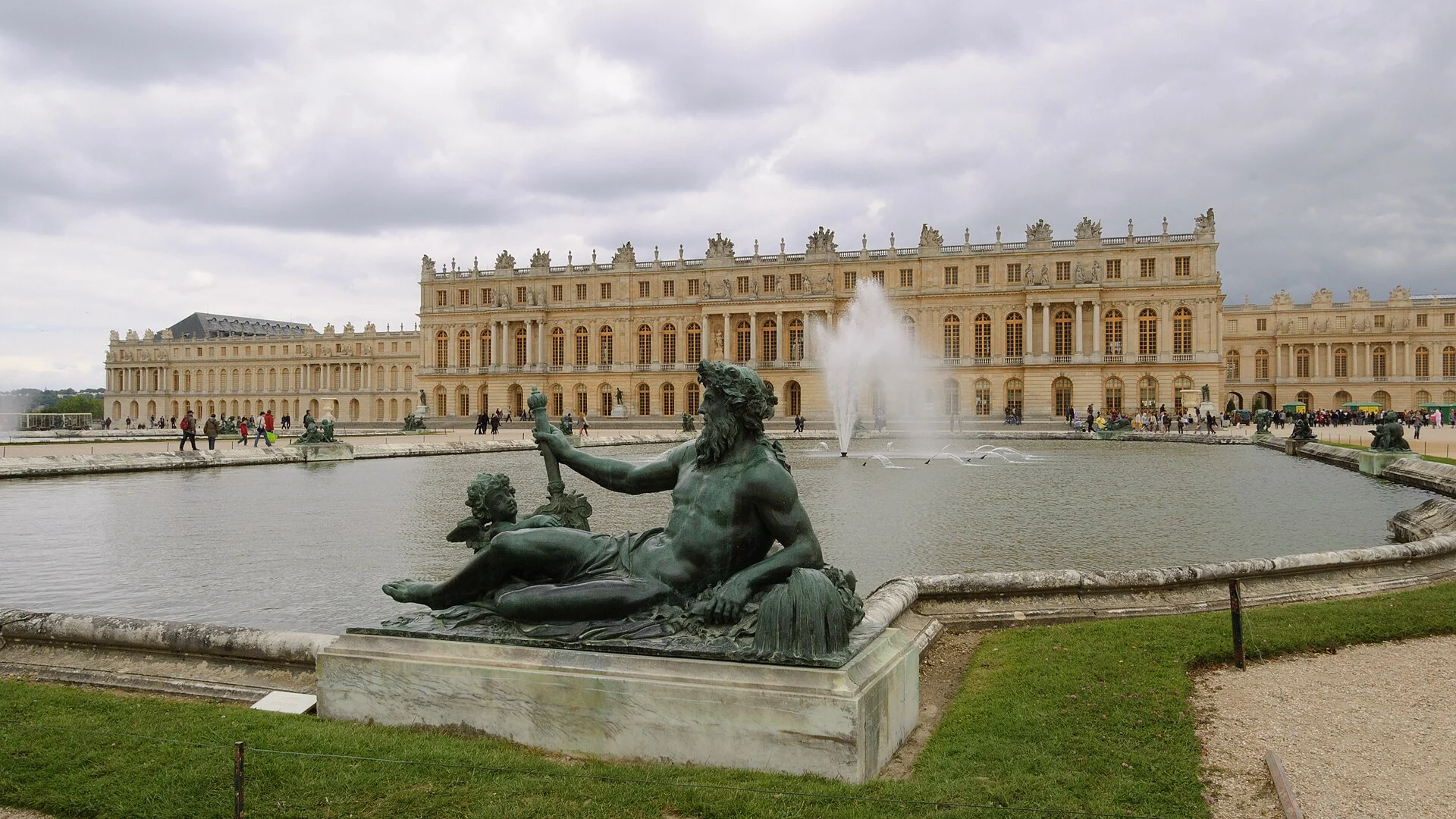
Full west façade of the palace with a bronze figure reclining in the pool before it

Versailles, France

Palace of VersaillesOne axis reaching the woods

Look in from the gatehouse and the pools, lawns, fountains and small woods recede in layers, the sky at the far end.

Northwest of the town of Versailles, with the Place d'Armes before the palace and the gardens spreading west.

PlaceVersailles, France
TypePalace and gardens
SuitsThose who want the gardens walked too, not just a photo at the gate

A walk down the central axis

Versailles, France — Palace and gardens.

Stand at the gatehouse end first.

The line ahead runs dead straight: first paving, then two stretches of still water, then lawns, with a group of bronze statues at the centre, finally gathered in by the woods. Reclining bronze figures lie at the pool's edge, their colour darkened, the water holding clouds and rooftops until a breeze wrinkles it. The trees by the parterres are clipped into cones and balls, standing in rows along the gravel paths, their shadows short enough not to block the way. Many walk here, yet the sound disperses; the further west you go, the more it's only the crunch of gravel underfoot.

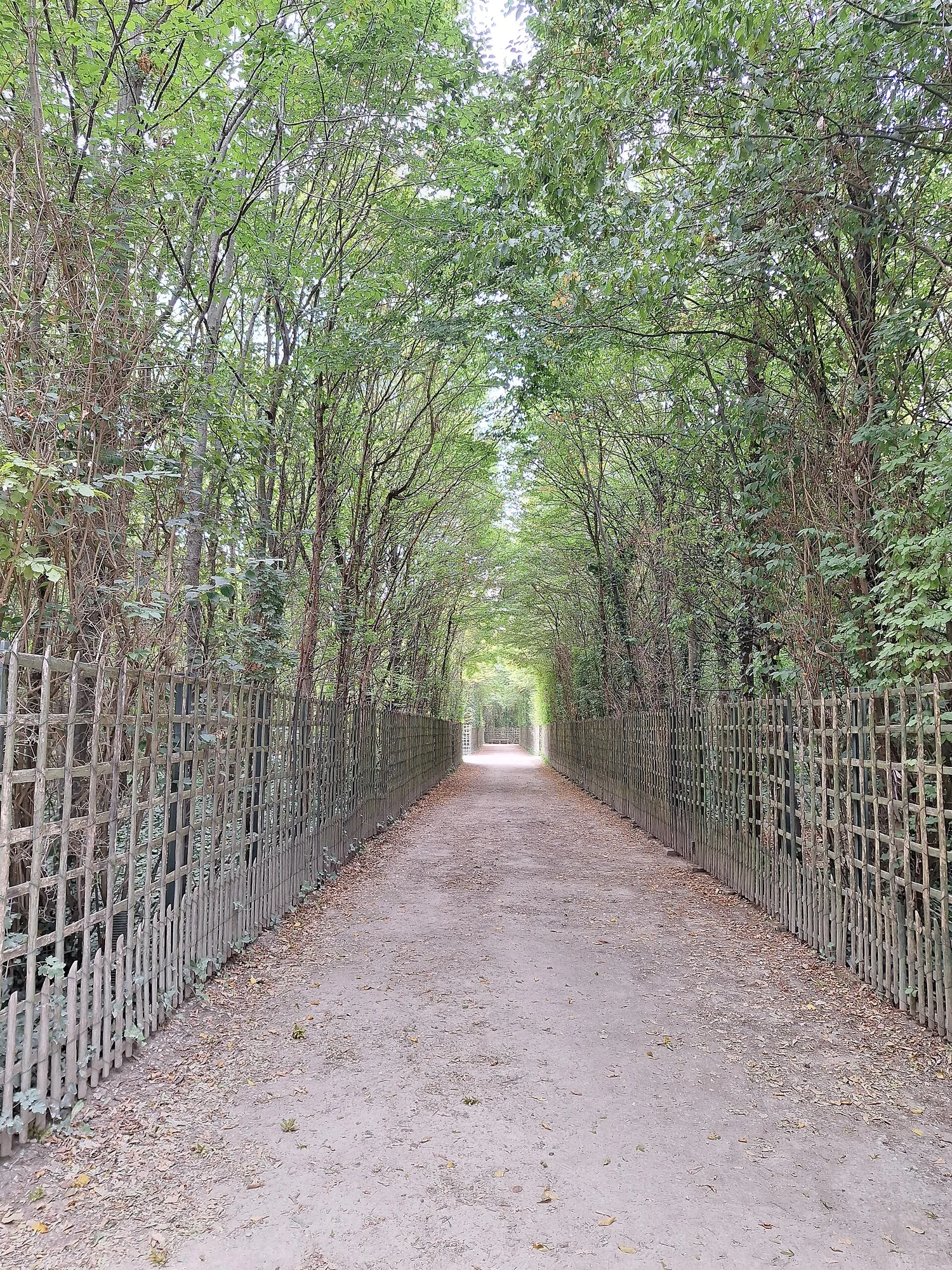
Turn into a side avenue and the light suddenly breaks. Two rows of tall trees tunnel the path between them, a small patch of white bright at the end, several minutes to reach. Outside the tree lines are lattice hedges, through which you can see the parterres on the other side. Look back and the palace becomes a gold edge in the distance — only now can you tell how long that straight axis really is.
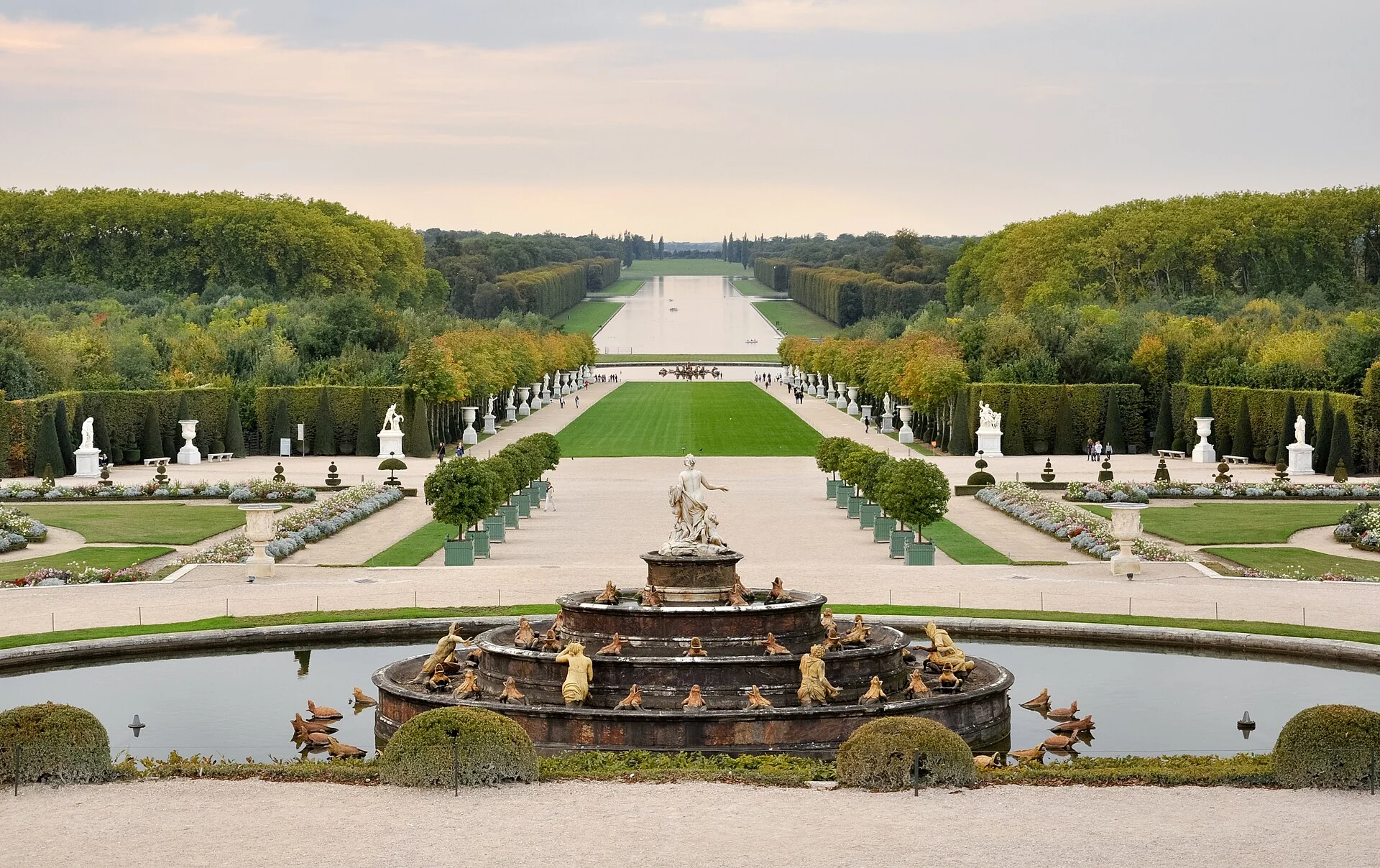
Garden axis with white statues on both sides and woods at the end
The axis runs west
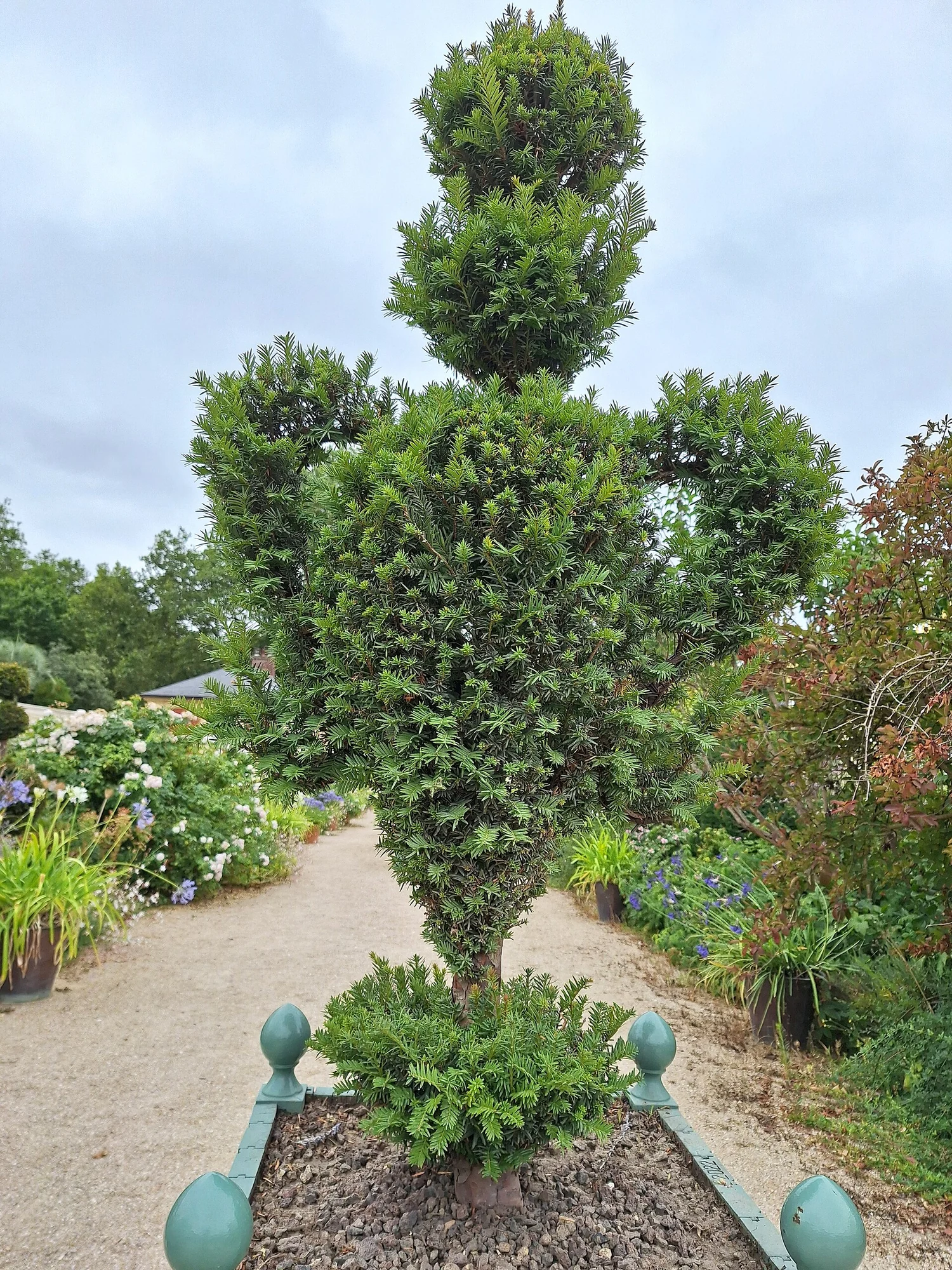
Trees clipped into balls in a parterre beside a pale gravel path
Ball-shaped trees along the path
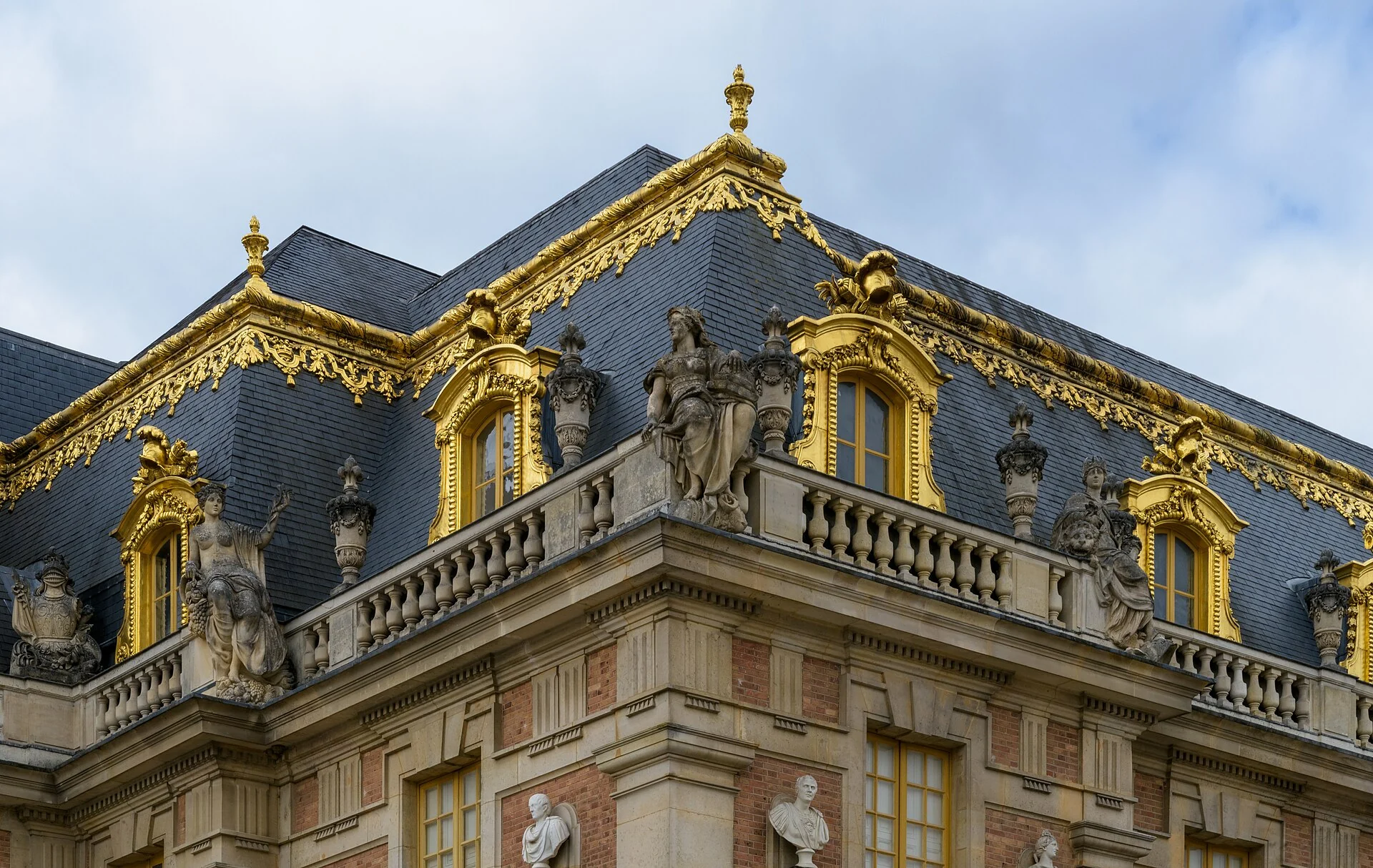
Gilded cornice and window-frame detail on a dark roof

The bronze figures by the pool

At the four corners of the main pool recline bronze human figures, leaning outward, the water reaching only the edge of their plinths. The verdigris pools deepest at the joints; the shoulders are worn bright. They don't face one way — turn half a circle at the pool's edge and each figure frames a different piece of garden behind it.

A tree-lined avenue between two rows of tall trees, light at the end

Gold lines on the dark roofs

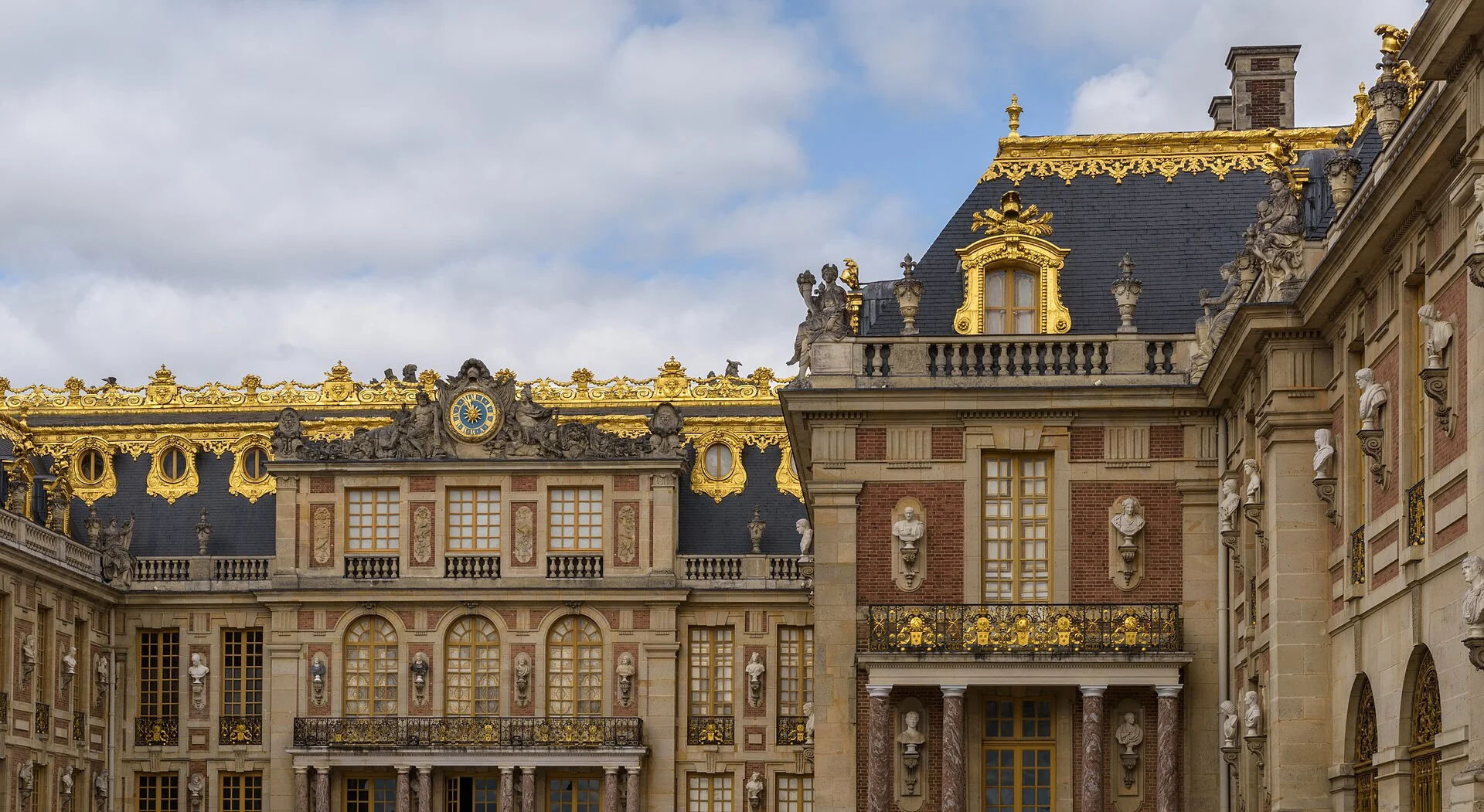
The roof facing the courtyard is dark; the cornice, window frames and railings carry a gilded bright edge. Up close the restored patches and the old areas sit in different tones, and a row of small ornaments stands along the ridge. On cloudy days the gold looks dull; the moment the sun comes out the whole cornice lights up.

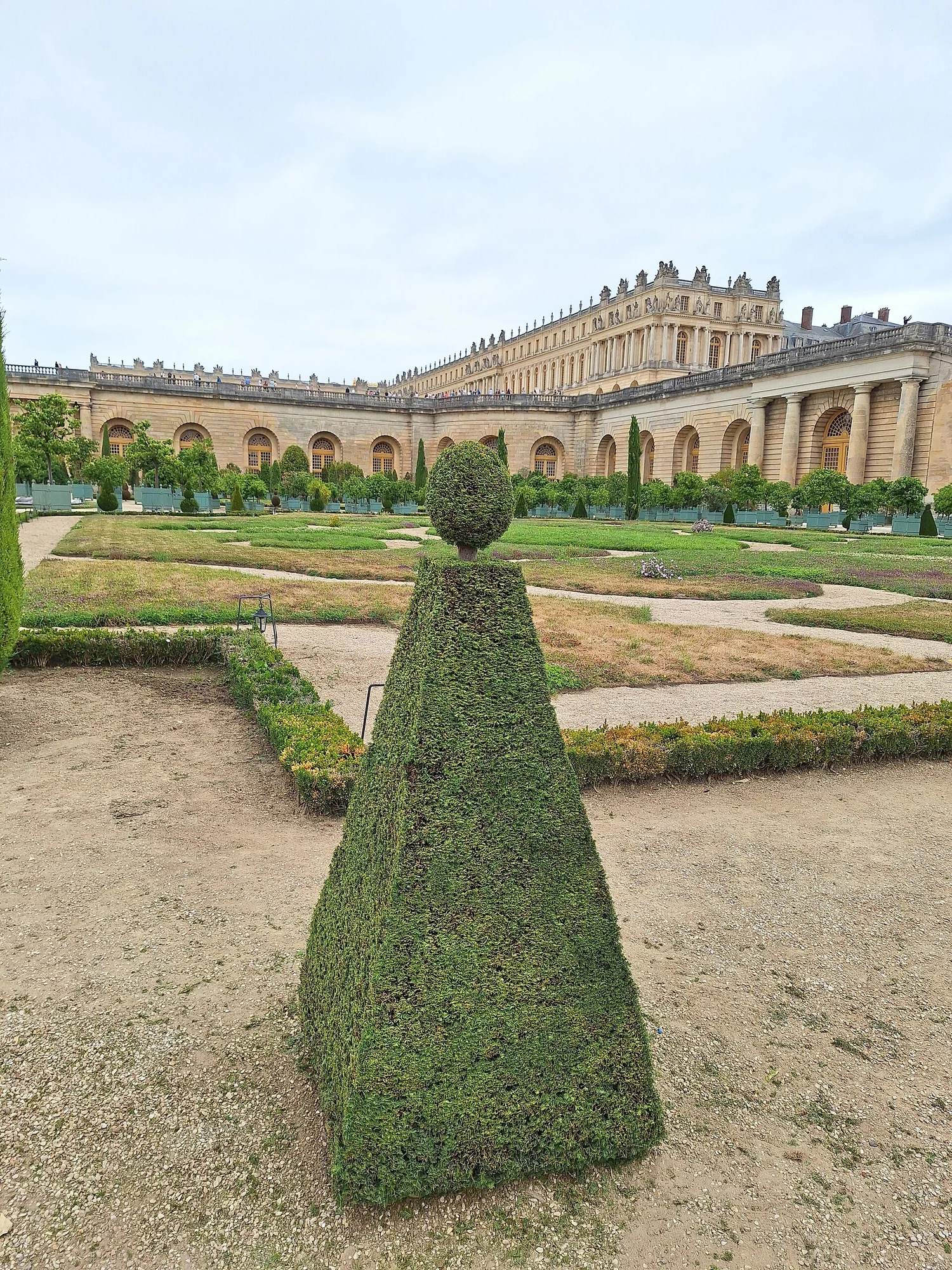
Cone-shaped shrubs with a parterre behind and the long palace façade in the distance

Trees clipped into cones

Several shrubs by the parterres are cut into cones, wide at the bottom and pointed at the top, paired with spherical low trees and a ring of bare soil and gravel at their feet. The clipping is even, yet new shoots poke through the seams. Their job is not shade but to mark the intervals along that straight line.

Front of the golden gatehouse with its dark-tiled roof
Route

A day for Versailles

Don't put it on the day you arrive in Paris. Stay a night, give the next day entirely to Versailles, and you can still return for a city dinner.

A hunting lodge of 1623

This ground is mentioned in a monastery deed of 1038, and in the Middle Ages it was a few villages, farmland and woodland. In the sixteenth century it belonged to the Gondi family, people of standing at court. Louis XIII bought part of the land in 1623 and completed the rest in 1632.

What he built first was not a palace but a brick-and-stone hunting lodge, about thirty-five metres long, with a central block and a wing on each side, surrounded by marsh. Red brick, white stone and blue-grey slate set side by side earned it the jeering nickname 'the shabby château' or 'the card-house château'. The great palace later grew around that little lodge.

The lodge fixed the axis. Every later expansion pushed west along it, and the garden's symmetry was measured from that line. Stand at the gatehouse today and you can see straight to the woods not because of one plan but because generations never changed direction.

The court that moved in, in 1682

Louis XIV formally moved the court and government here, taking up residence on 6 May 1682 and staying until 6 October 1789, apart from the Regency of 1715–1723 when Paris was the seat again. Louis XV and Louis XVI followed. The palace was his largest building project and is taken as a masterpiece of French classical architecture; many European palaces and decorations of the eighteenth and nineteenth centuries followed its lead.

Its scale can be guessed from numbers: about 63,000 square metres of floor area, roughly 2,300 rooms, of which about 1,000 belong to the Museum of French History housed in the palace and at Trianon. Courtyards, palace blocks and side wings nest one inside another, yet from outside the skyline stays as even as possible.

Before 1682 this was a royal residence visited now and then; after, it became a place where government and daily life happened at once. Room functions changed many times; only doorframes, panelling and ceilings show the layers, and the furniture and furnishings are long since not original.

The gardens larger than the palace

Today the estate is about 815 hectares; before the Revolution it exceeded 8,000. The formal French gardens within it cover 93 hectares. Beyond the gardens lie the Grand Trianon, the Petit Trianon, the Queen's Hamlet, the Grand and Petit Canals, the Orangerie, the Swiss Pond and the former menagerie.

These names spread far and can't be covered in one visit. Most people stay near the axis; walk a few hundred metres sideways and the voices fade. The avenues, parterres and pools each have their own scale, understood best on foot.

A full day southwest of Paris

The palace is northwest of the town. Do the interiors in the morning, descend to the gardens from the west façade in the afternoon, then loop toward the tree-lined avenues — adjust the order to the day's open areas.

Time needed

A full half-day to cover the palace plus the French gardens; allow extra time to reach the far end of the Grand Canal

Best light

Summers are harsh with little shade in the gardens; spring trees are just green, autumn leaves darken — check current conditions for the light you want

Getting around

The gardens spread wide with much gravel underfoot; slow walking suits better than rushing. With children, shorten the route. Check current notes for step-free access

What's open

Fountains and estate events follow the season; confirm which areas are open in the current period

Talk through my trip idea

If you're planning your days in the Paris suburbs, tell me whether you mean to spend half a day or a full day, and whether anyone in your group walks slowly.

[email protected]

Read this page in Chinese

Discuss this journey