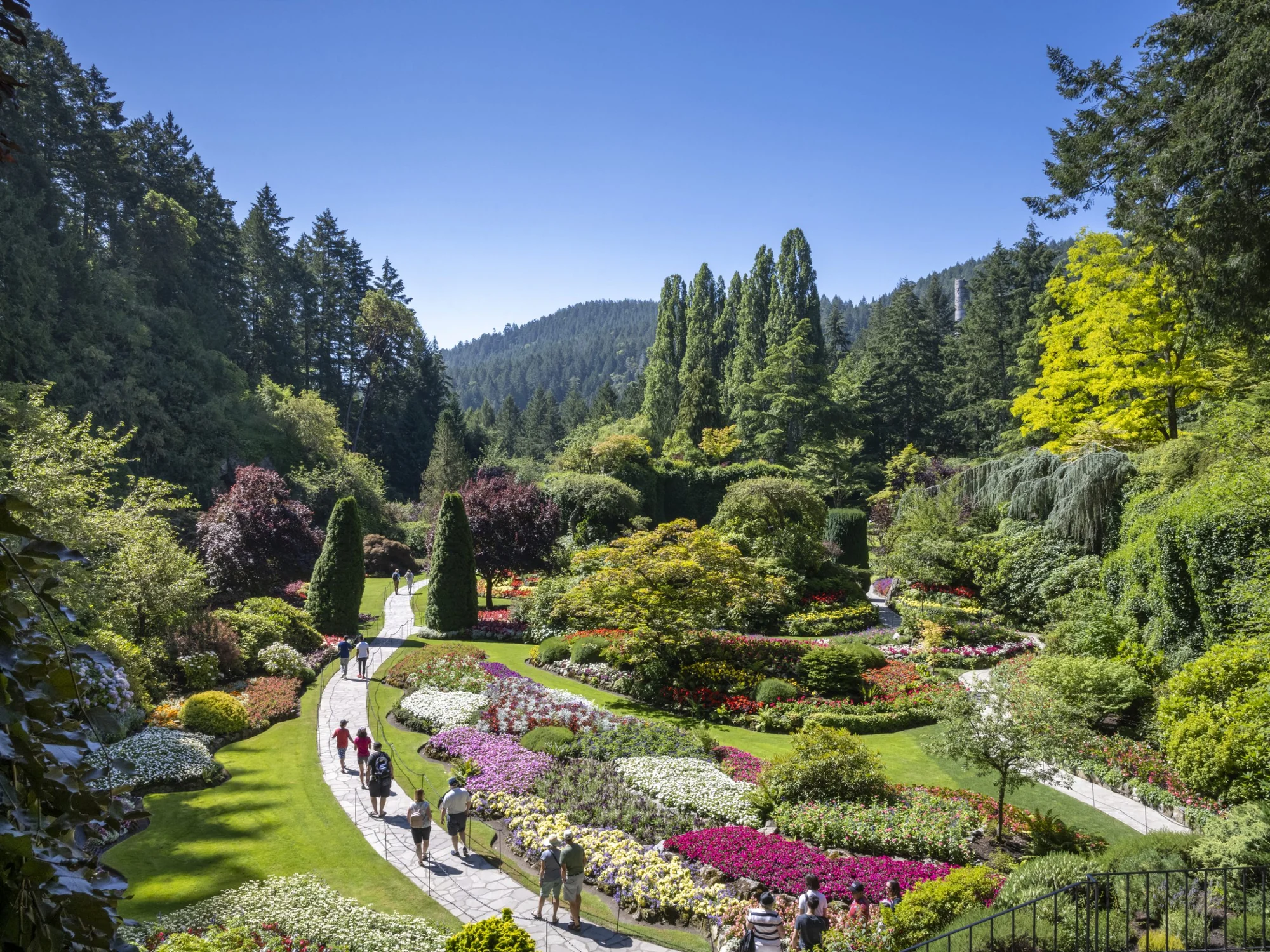
A full view of the Sunken Garden, flower slopes and a curving path framed by clipped shrubs

Victoria, Canada

Butchart GardensFlower slopes rising from the pit floor

From above, a path bends through the flowers, the slope clipped into layers of green with a few tall trees at the end.

At the southern tip of the Saanich Peninsula on Vancouver Island, by Tod Inlet, a slope not far from Victoria.

PlaceVictoria, Canada
TypeFlower gardens built in a quarry
SuitsHalf-day garden walkers and families trading the shade for the flower beds

A pit grew into a garden

Victoria, Canada — Flower gardens built in a quarry.

First, take in that slope.

The several gardens sit close together, and a few steps change the scene. The Sunken Garden reads best from above — flower bands follow the slope down, low hedges rounding the edges; turn a stone stair and you are suddenly on a narrow path of only tree-shade and moss. A torii stands in the green, red and plain, its stone path running out of sight.

Water holds a place in several spots. Some jets up from a pool and breaks into mist with flowers right in front; some lies still in the middle of a bed, taking half the colour from each side. The planting changes densely — red, purple and yellow can stack into several layers in one plot; up close you see only the bed at your feet, and only from the stair do the patterns join.
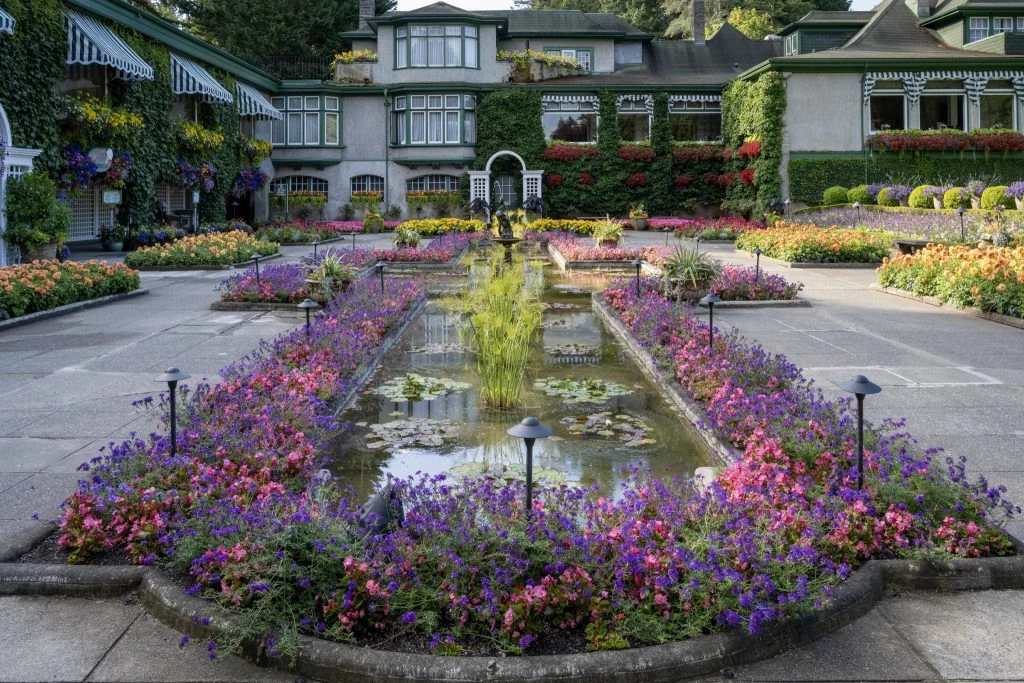
The building before the Italian Garden with oval beds and a thin pool between
The symmetric beds of the Italian Garden
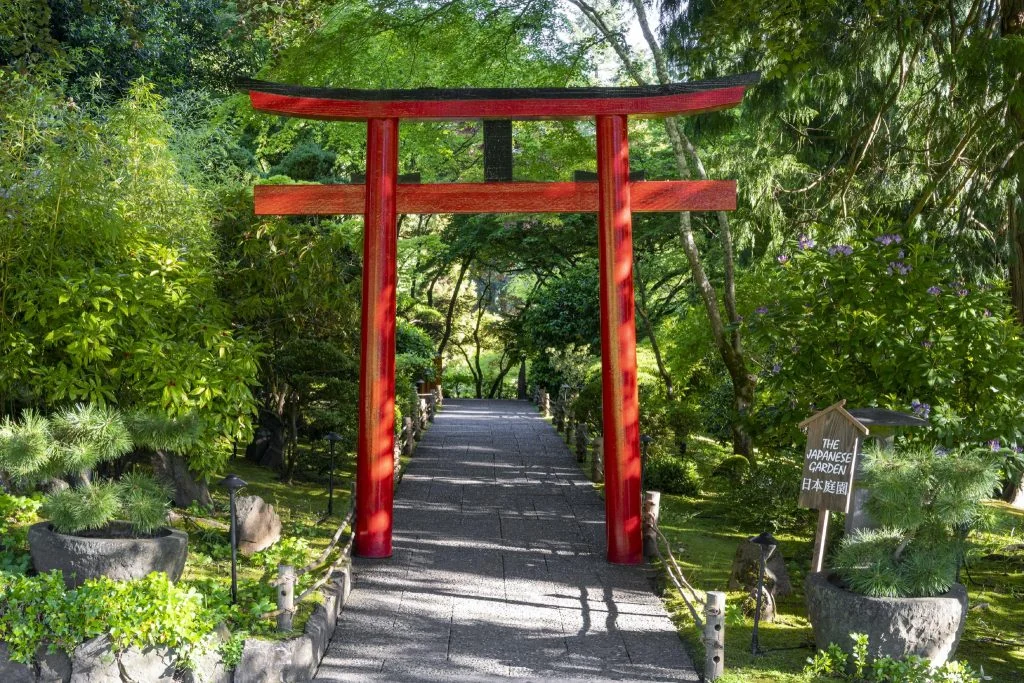
The red torii of the Japanese Garden standing among green trees, a stone path leading in
The red torii standing among the green
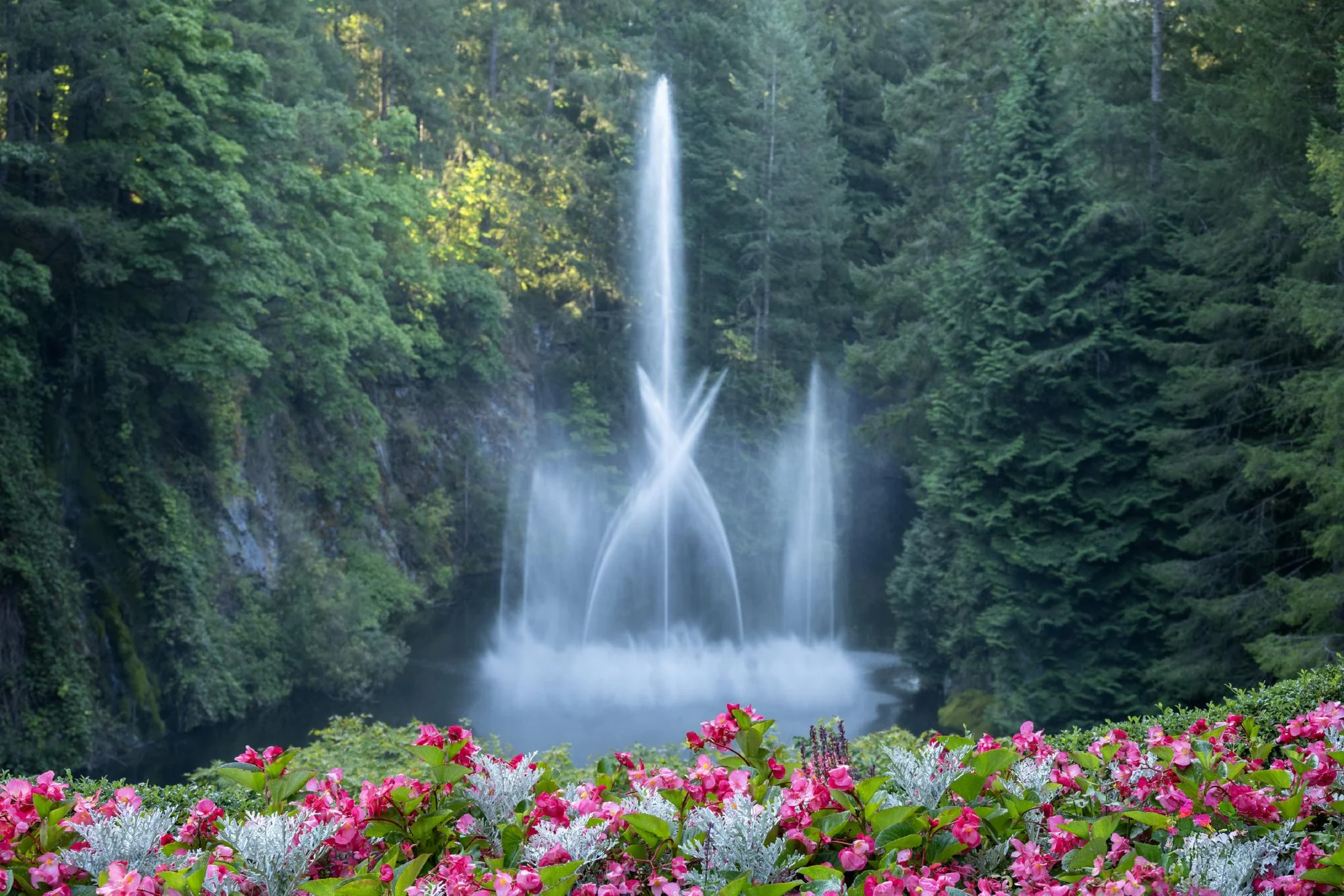
Ross Fountain jetting water with a ring of pink and purple low flowers in front

Flowers before the water jets

Several streams shoot straight up from the pool and fall into a sheet of white mist. Behind, dark-green conifers set the water glowing. Low flowers crowd the pool's rim, pink and purple pressed together, and when the wind comes the water and blooms sway as one.

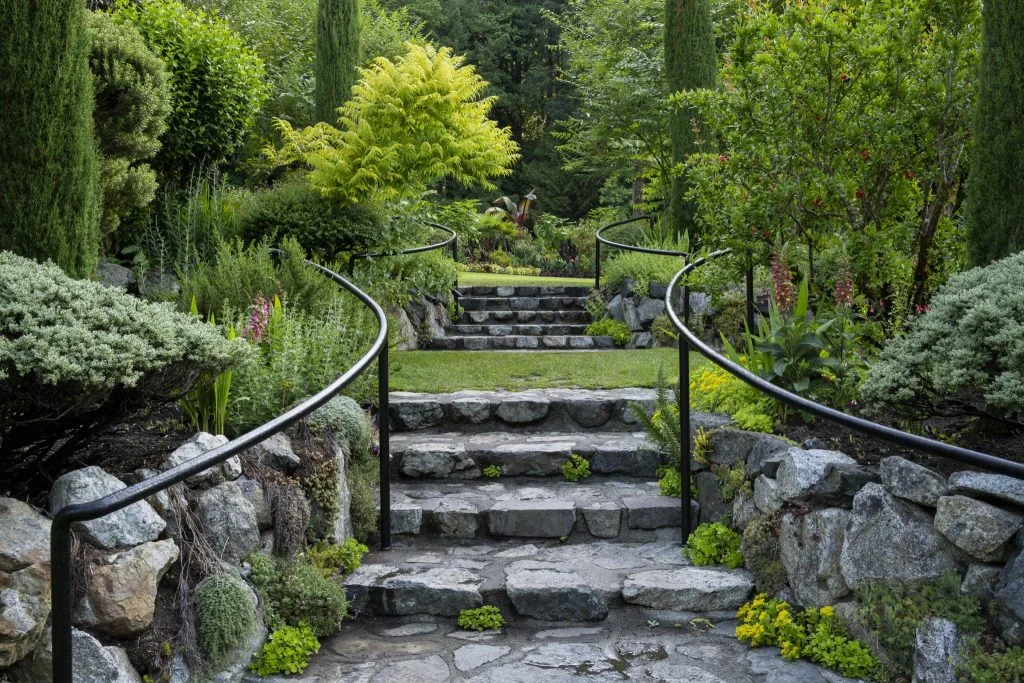
A stone stair climbing between two large rocks, bushes trimmed into rounds on both sides

The stair turns into the shade

An old stone stair climbs between two large rocks, its rails curving gently, the stone worn bright. Trimmed shrubs droop on the left, and on the right a yellow-green tree gives up its light. A sliver of bench shows at the top, then it is out of sight.

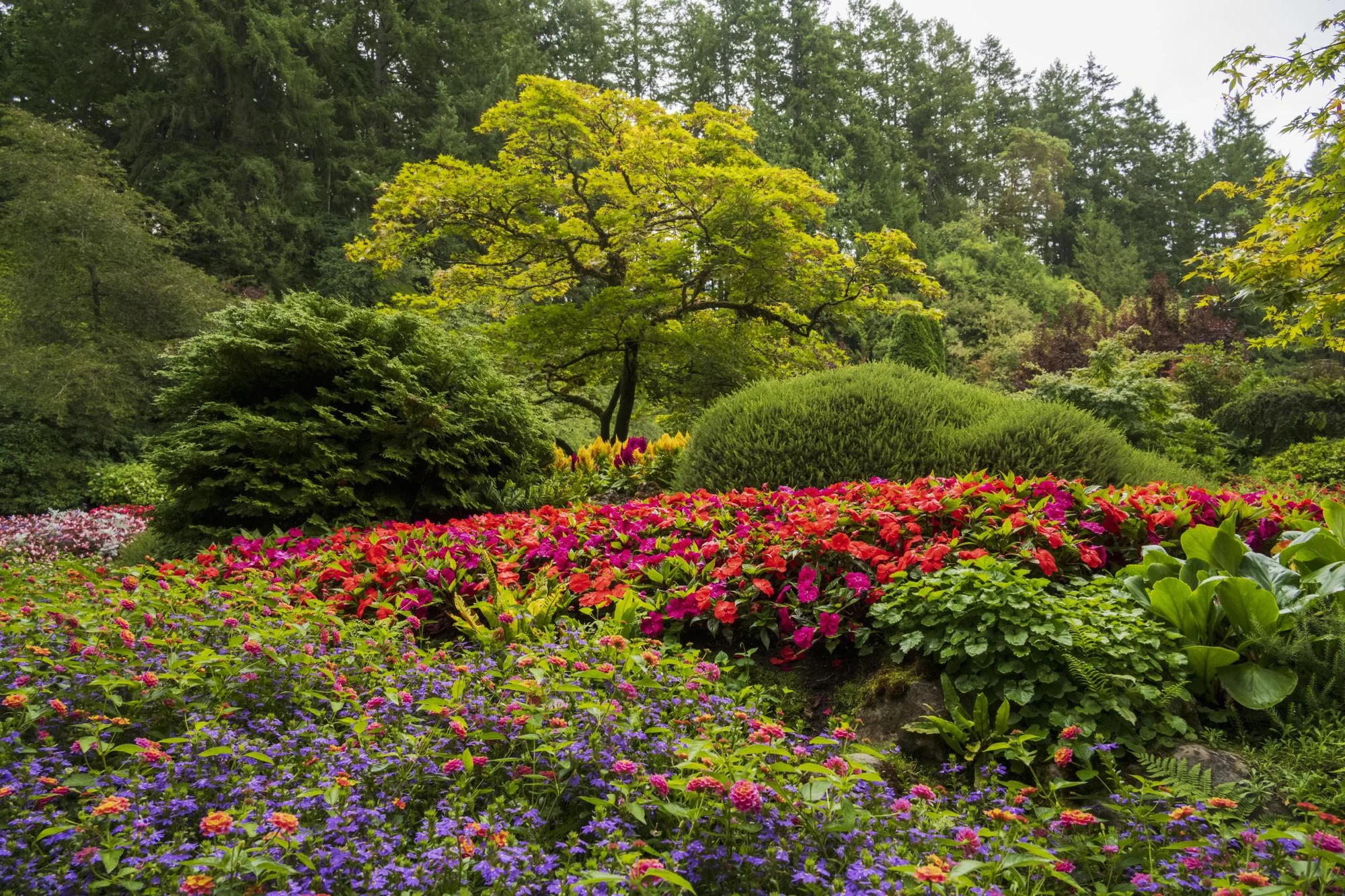
A wide red and purple bed reaching the clipped shrubs, white flowers mixed in

Flower beds reaching the shrubs

A great spread of red and purple runs out, a low green rim holding the edge, clusters of rounded shrubs behind keeping the height down. Stray whites are mixed in, colour layered over colour. The flower band rises and falls with the land so you cannot see where it ends.

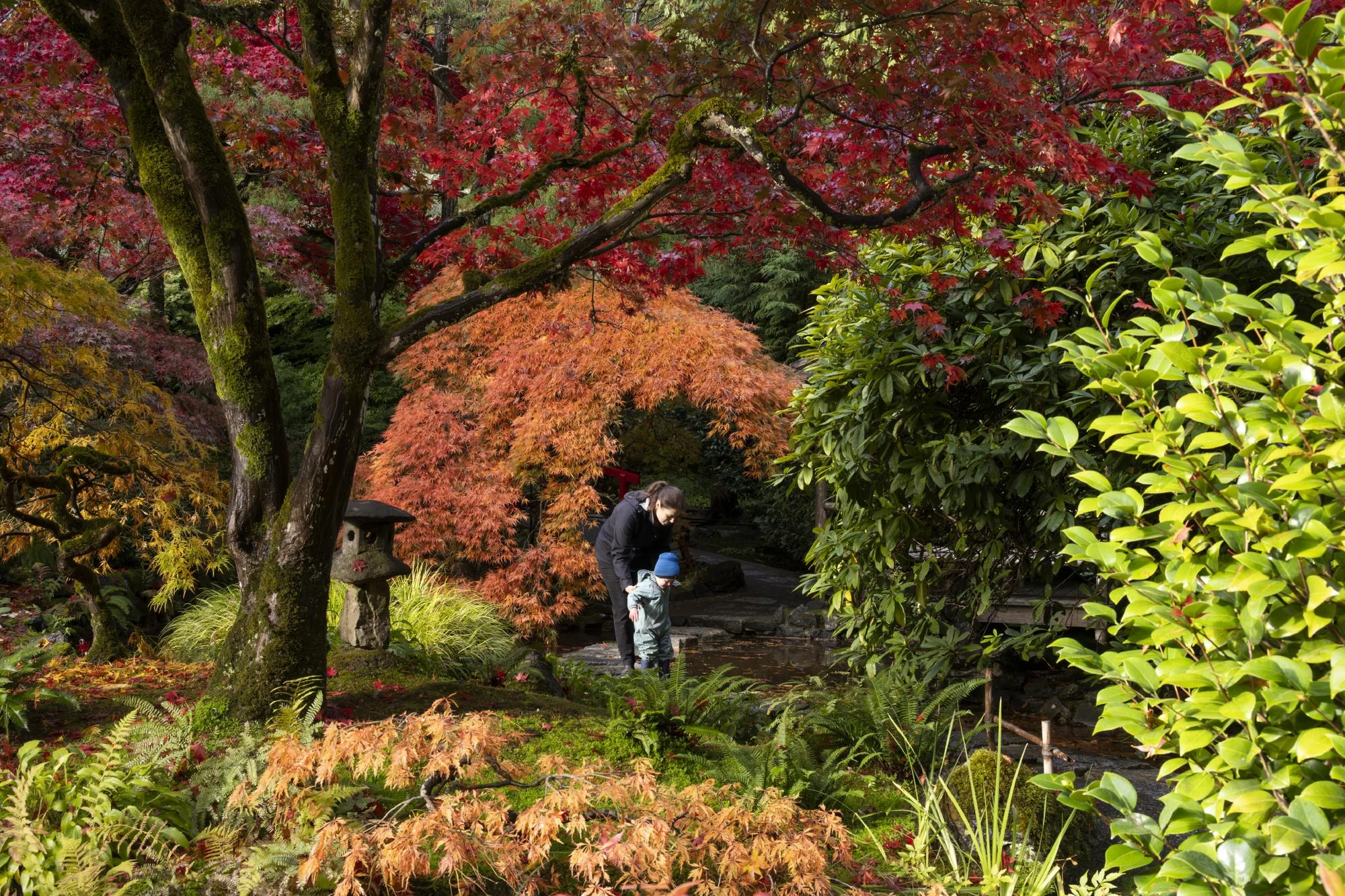
Someone walking the woodland path beneath maples turning red in autumn
Route

A full day you leave for Vancouver Island

Do not schedule it for ferry day; stay a night in Victoria, enter the gardens the next morning and return to the city after.

Cement first, flowers later

In 1888 Robert Pim Butchart began making Portland cement near Owen Sound, Ontario. He and his wife moved to the west coast for the limestone the cement needed, and in 1904 they settled by the Tod Inlet quarry. Back then the grounds were a worksite, not a garden.

When the limestone ran out in 1909, Jennie set about turning the spent pit into the Sunken Garden, work that ran to 1921. Looking down today, the flower slopes step down along the original pit walls, and the bending path is the old way down to the bottom. The landform was not levelled — it became the garden's most recognisable feature.

More gardens were added later. In 1926 the tennis court became the Italian Garden; in 1929 the kitchen vegetable garden became the Rose Garden, designed by Seattle's Butler Sturtevant. The Rose Garden holds 2,500 plants across 280 varieties — the number sounds dense, but walking there you only catch the scent.

The torii and the fountain each have a source

In 1907, at sixty-five, the Yokohama gardener Isaburo Kishida came to Victoria at his son's invitation to build a tea garden at Esquimalt Gorge Park. Local notables asked him to add Japanese gardens at their estates, Mrs Butchart among them, and the gardens were completed before he returned to Japan in 1912. The compact walk behind that red torii still keeps its original feel.

In 1964 a shape-shifting Ross Fountain was installed in the lower reservoir to mark the garden's sixtieth anniversary. The jets keep changing height while the low flowers in front differ year to year, so from the same angle the water or the blooms are always new.

The gardens have very different characters. The Italian one is about symmetry, a thin pool splitting the beds in two; the Japanese one narrows the path to slow you down; the Sunken one opens the scale at once, best seen whole from the steps. The rhythm of a half-day comes from rotating through them.

Still in one family's hands

In 1939 the couple gave the gardens to their grandson Ian Ross as a twenty-first birthday gift. Ross ran them until his death, then his son took over; since 2001 the great-granddaughter Robin-Lee Clarke has been owner and managing director, and ownership remains in the family.

In 2004 two 30-foot totem poles were raised for the centenary, and that same year the garden was named a National Historic Site of Canada. When the maples turn red in autumn, the woodland path carries its deepest colour — walking it is quite another thing from the summer flower slopes.

The planting changes by season; do not take the bed in a photo as something always there. From the top step looking down, the layering of the pit walls outlasts the flowers.

Give the afternoon to the flower slopes and the torii

It is not far from Victoria; the garden's sections sit close, linking uphill and down into a loop.

Dates

Check current notices for open areas and the flower rotation; the blooms differ by season, so do not use old photos for the current layout.

Duration

The several gardens take half a day on foot; add one or two hours to turn down every side path.

Season

Spring brings bulb flowers, summer the densest beds, autumn the maples turning red; Vancouver Island sees plenty of rain, and the season changes how long you linger on the stone steps.

Talk through my trip idea

If you are planning your Victoria days, tell me whether you will leave half a day or a full day, and whether there are children with you.

[email protected]

Read this page in Chinese

Discuss this journey