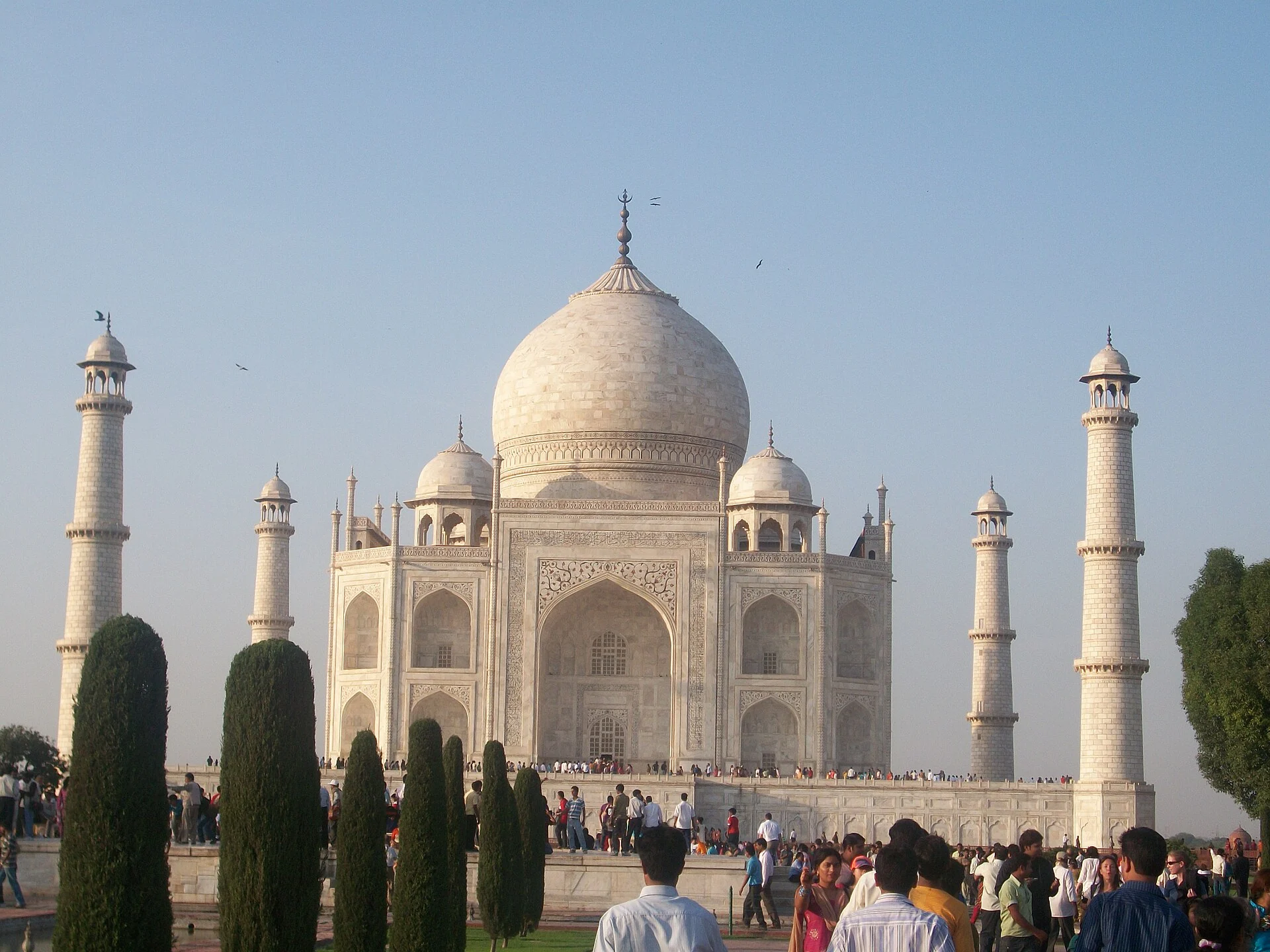
White tomb front, dome and four slim towers symmetric, cypresses flanking

Agra, India

Taj MahalA white building identical on all four sides

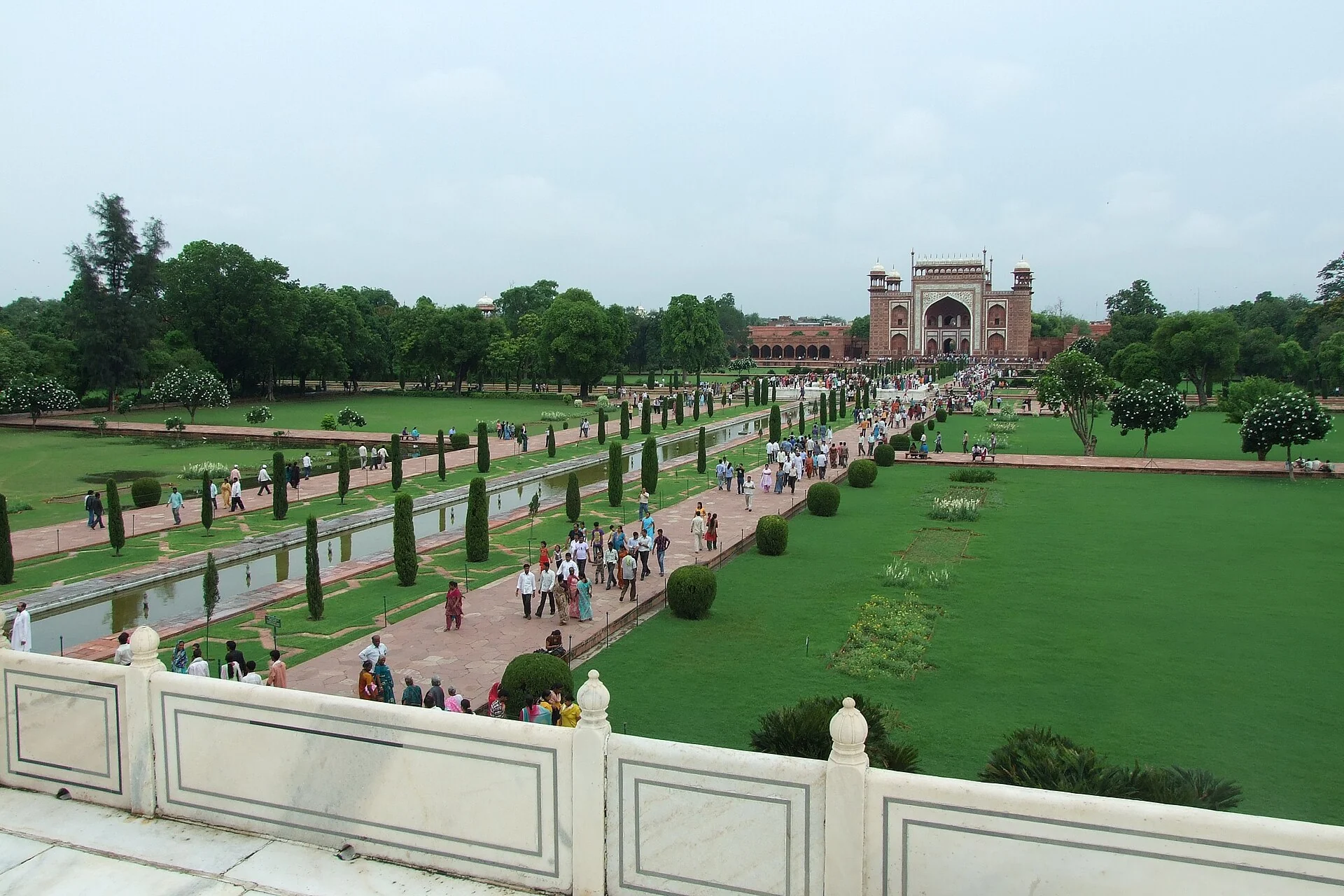
From the gatehouse the white tomb sits squarely at the axis end. Up close the colour is not single: the base and side buildings are ochre-red, and the white is reserved for the one in the middle.

On the right bank of the Yamuna, a wall separates the garden from the city, and the river wind comes from behind.

PlaceAgra, India
TypeMausoleum complex
SuitsThose who want to see why the white is reserved for the centre and the four faces read identical, not just a front photo
Best seasonDry-season light is harsh and the white marble blows out; thin cloud or raking sun shows the inlay and red-white layers

The division of white and red

Agra, India — Mausoleum complex.

First stand in the gatehouse and see how the tomb is framed by the arch.

Walk a full circuit of the base; all four façades are almost identical.

Save time for the inlay lines and lettering on the stone, alongside the outline.

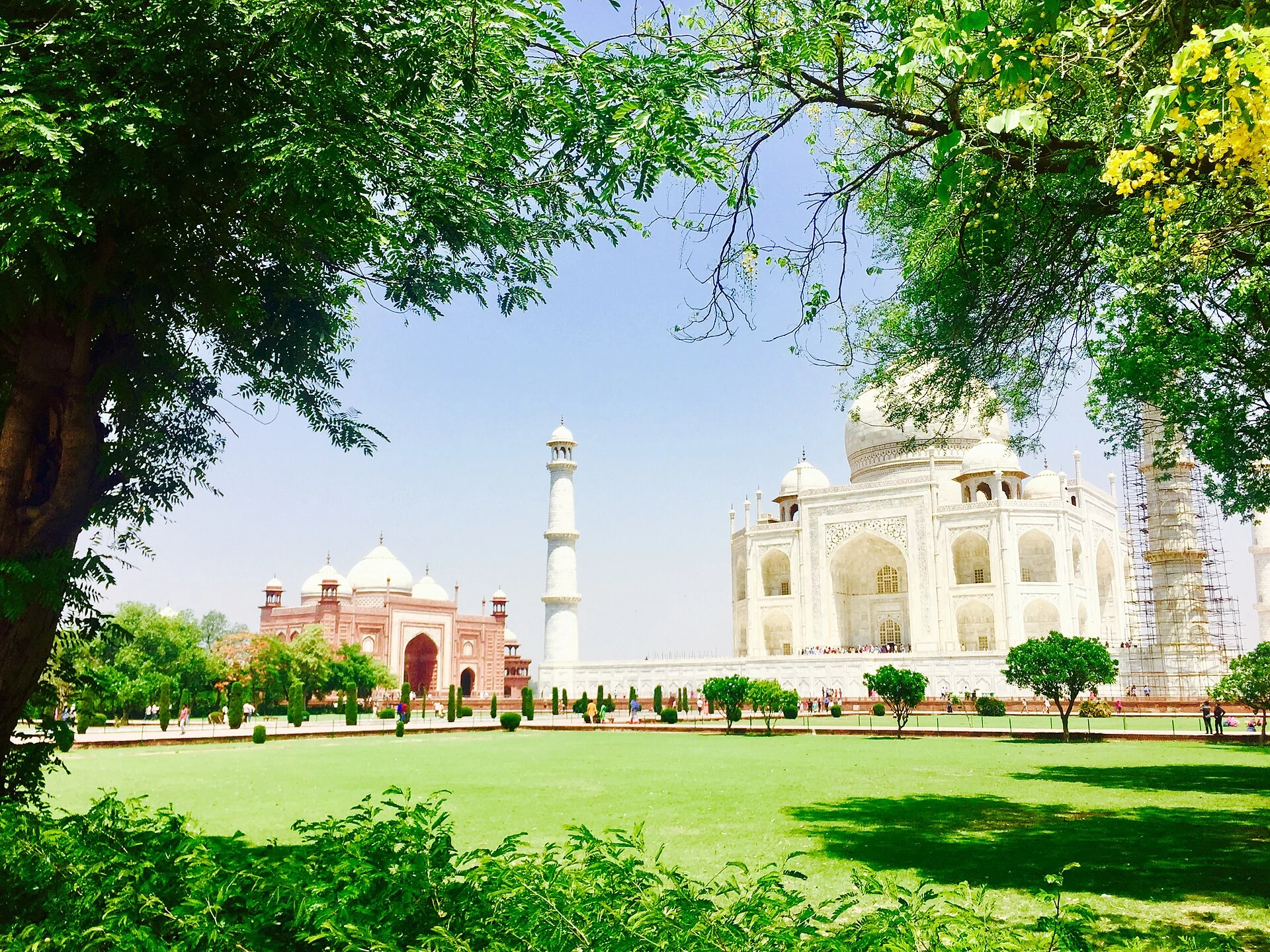
Tomb seen diagonally from shade, foliage above, a slim tower showing right
The dome in the tree shadow
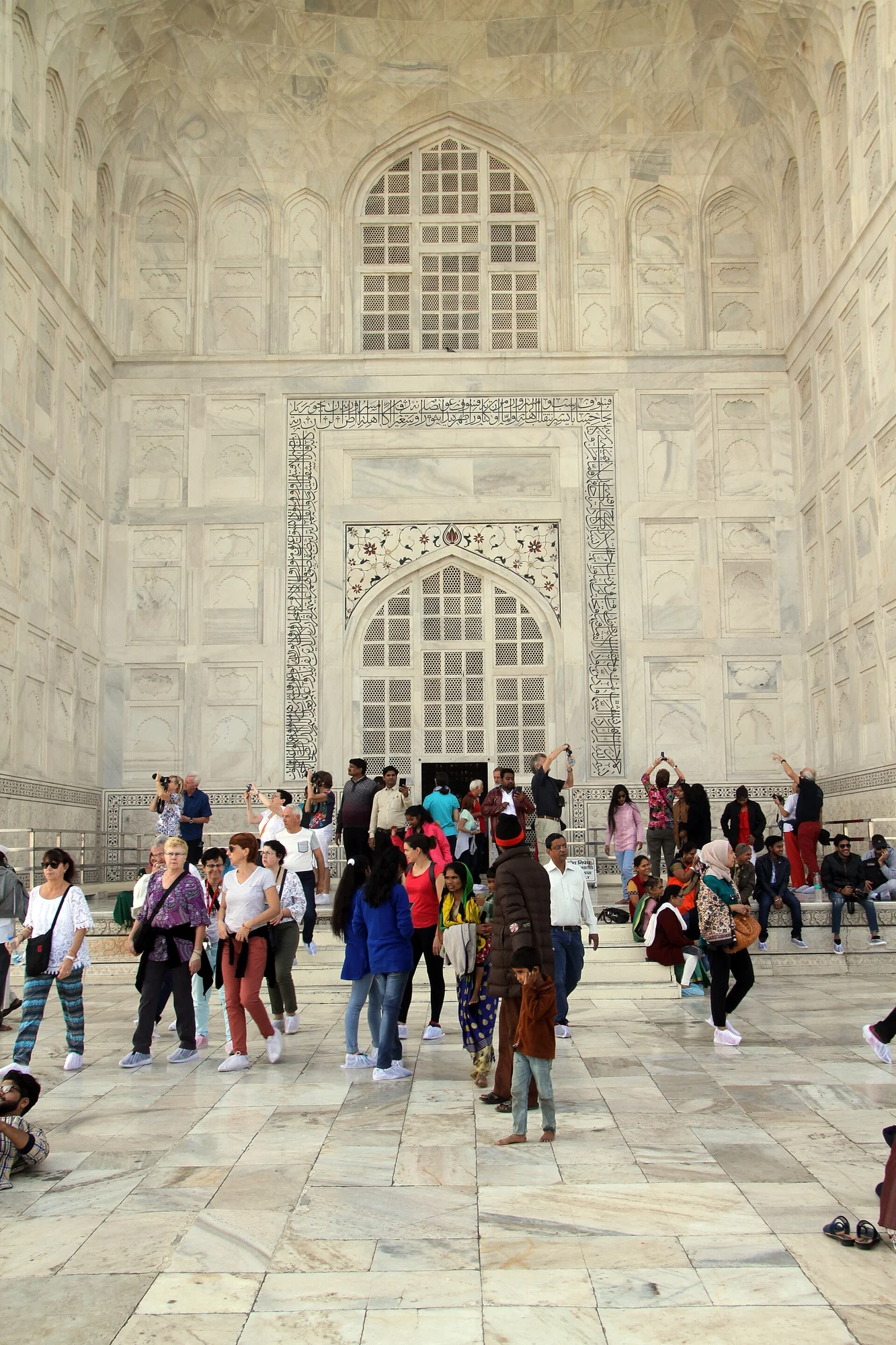
Marble wall, fine inlay within an arched frame, a row of people before it
The fine inlay lines on the wall
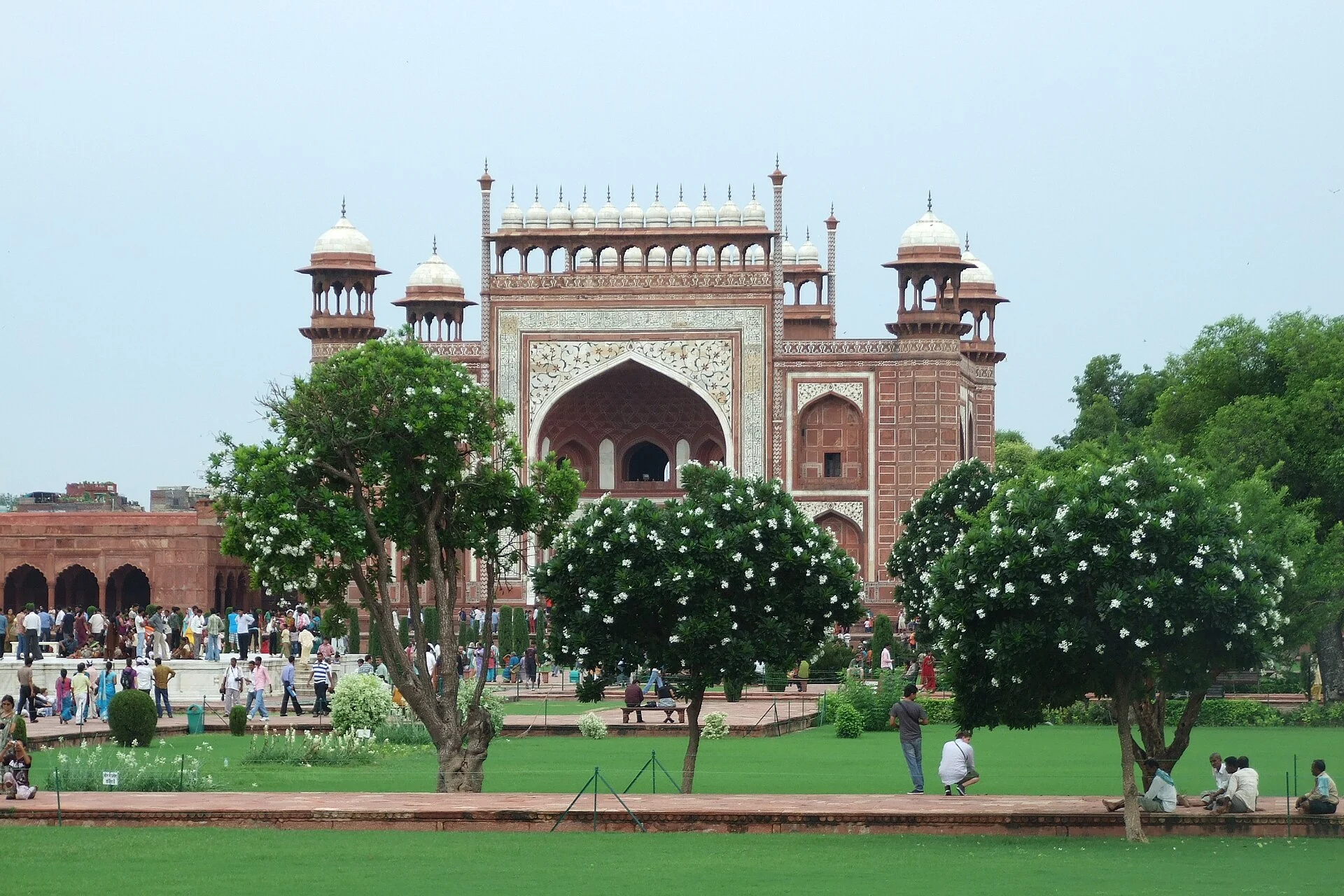
Red sandstone front, a great central arch with a small tower each side, trees on the lawn

One drawing for all four faces

The tomb sits on a square base 95.5 metres on a side and six metres high, chamfered into eight faces. Each façade opens a single arched doorway, the outer frame a 33-metre great arch, with two smaller arched balconies stacked on each side. Above sits a 23-metre dome; from whichever side you look, the proportions line up.

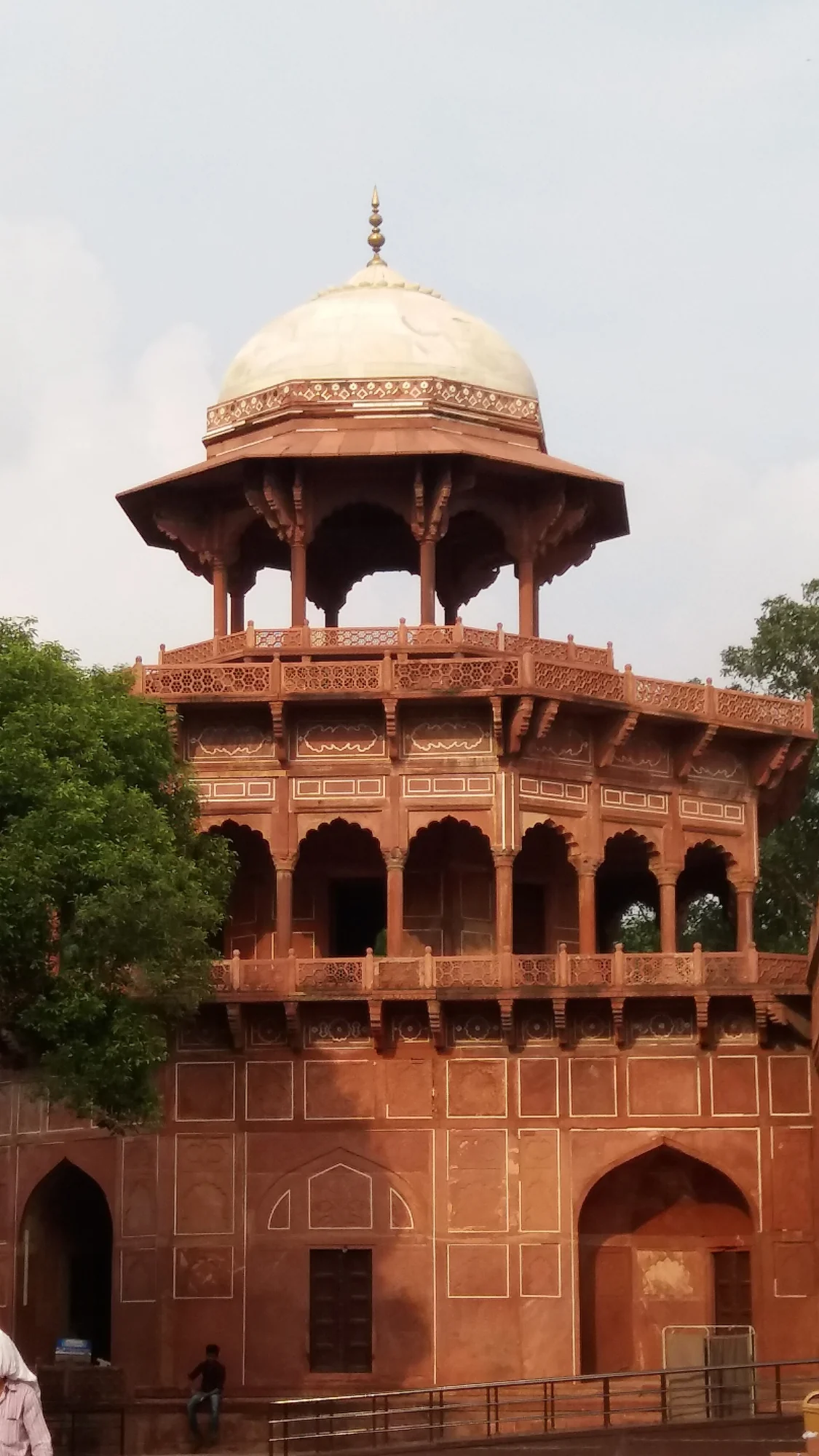
Red sandstone turret, arched windows under an octagonal eave, trees around

Red sandstone steps aside for the centre

Across the seventeen-hectare site, the mosque, guest house and gatehouse use red sandstone, in keeping with contemporary Mughal building; white marble is reserved for the tomb itself. The two colours lead and follow, so standing in the garden you know without being told which way to go.

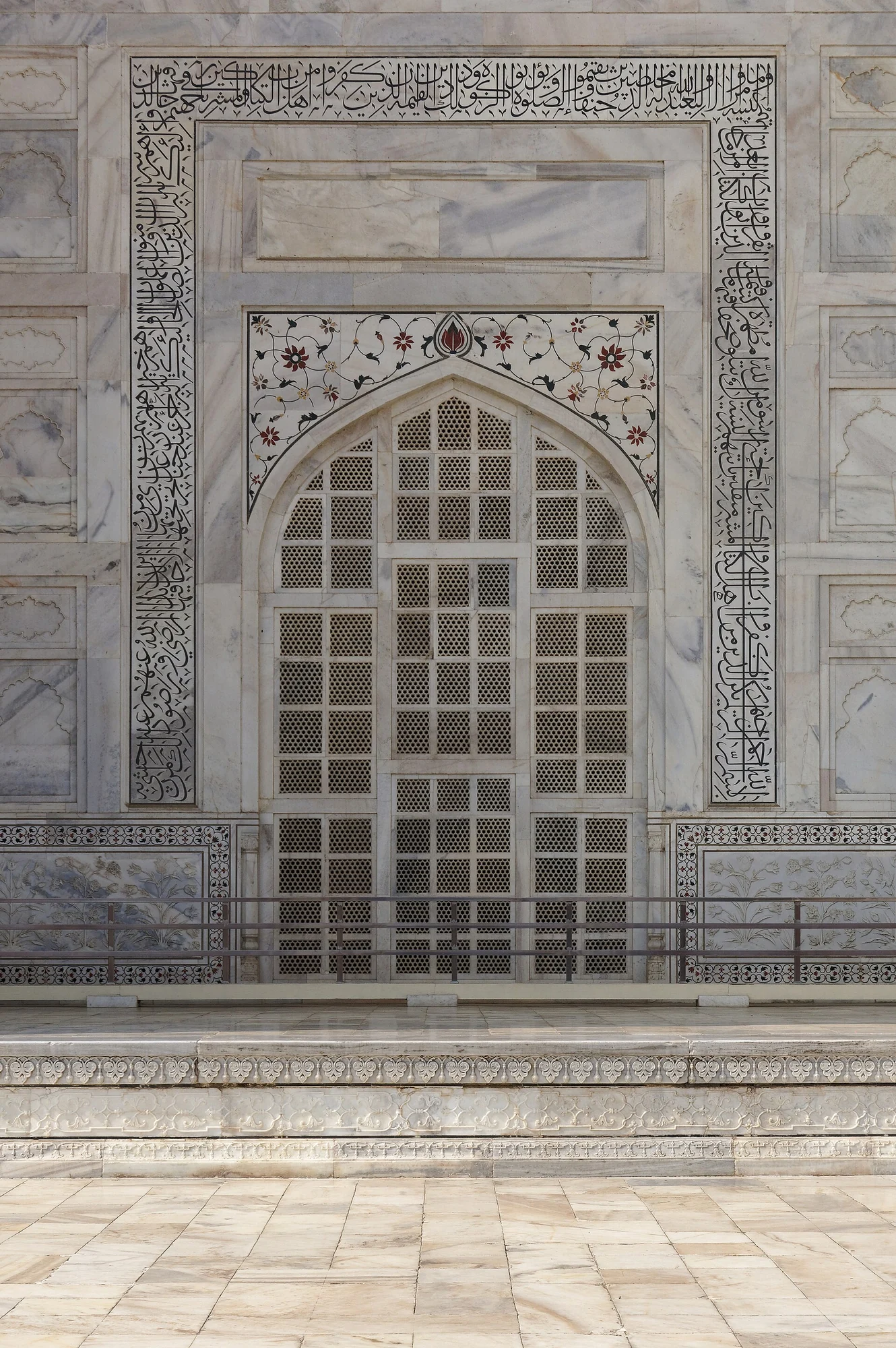
White marble arch, a grid grille and scrolling vine pattern within the frame

The fine work on the stone surface

On the white marble, vines and blossoms are inlaid from thin slices of coloured stone, the seams so fine you must lean in to see them. The whole effort drew more than twenty thousand craftsmen, overseen by a team led by Ustad Ahmad Lahori, with the dome, finial and calligraphy each in specialist hands.

Path by the wall and a wide lawn, a touch of red sandstone roof in the distance
Route

A morning on the south bank

Don't put it on your travel day. Stay in Agra the night before and set out at first light, so you're heading back by the time the stone is hottest after midday.

The building schedule of a tomb

In 1631 Mumtaz Mahal, wife of the Mughal emperor Shah Jahan, died, and he resolved to build her tomb on the south bank of Agra. Work broke ground the next year; the tomb itself was completed in 1648, and the gardens, mosque and guest house took five more years, the whole complex ready in 1653.

The site had been the mansion of a noble in the city, exchanged for a large house in central Agra. The riverbank was open, so the builders first raised a 300-metre-long, 8.7-metre-high platform, laying out light and dark sandstone in a pattern on its surface to lift the whole building off the floodplain.

The form did not appear from nowhere. The Timurid tomb at Samarkand and Humayun's tomb in Delhi gave the models; the charbagh and the octagonal plan were carried on from there. In 1983 the complex was inscribed as a World Heritage Site.

Colour tells the order

The moment you enter the gatehouse, only one white building sits at the axis end. The ochre-red side buildings and four slim towers each hold their side, narrowing the view; the further you walk, the more the white fills the frame. This ordering rests on a division of materials, not on piled-on decoration.

Above the base, the four façades use the same great arch and double-tier small arched balconies, and at the chamfered corners the pattern is repeated at a smaller scale. The dome gathers at the centre. Symmetry taken this far gives a sense, circling round, of returning to where you began.

Inside, the light is faint and the inlay reads more clearly in the dark. The Qur'anic letters on the arch grow larger with height so they aren't flattened by perspective; the screen and the cenotaph are a later layer, not the same as the geometric order outside.

Along the water channel, inward

The gatehouse itself is red, its arch very high, and standing in its shadow frames the white tomb as a picture. This distance is deliberate: first see the whole from afar, then walk the water channel in, and the building grows inch by inch.

The garden is cut by the water channel into four parts, the lawn trimmed low. Reaching the base means removing your shoes; the stone is scorched by the sun, with stairs on either side. The four slim towers stand at the base's corners, to be taken in only by looking up close.

Once up, don't rush inside. Circle halfway round the base; the river is beyond the wall, with grey-green flats on the far bank. Look back, and the axis you walked re-lines the gatehouse, the channel and the tomb into one straight line. The white marble now reads warm, not the same colour as in the morning shade.
A morning for the south bank

Finish the view from the gatehouse shadow first, walk the water channel to the base, circle halfway to the river, then go inside last.

Time needed

A morning for the gatehouse, water channel, base and inner chamber; add time for the rest of Agra

On the day

Some areas rotate closures and the inner route often changes; check notices for what's open

Getting around

Paths are level; reaching the base means barefoot on hot stone steps — go early or late

Season

Dry-season light is harsh and the marble overheats; thin cloud or slanted sun is better — check the weather first

Talk through my trip idea

If you're planning your Agra days, tell me whether you want a morning or a half-day here, and whether anyone in your group fears the sun or moves slowly.

[email protected]

Read this page in Chinese

Discuss this journey