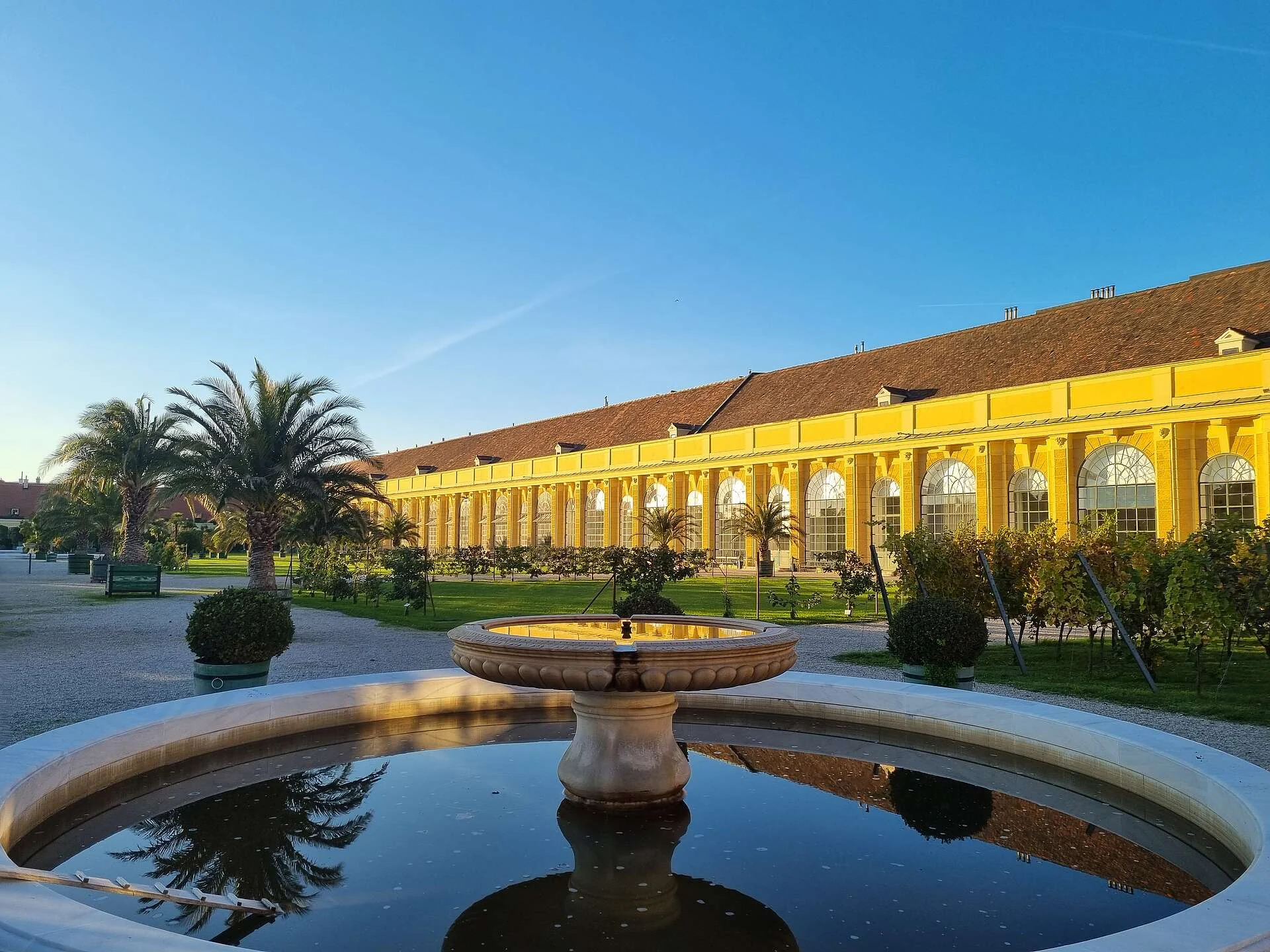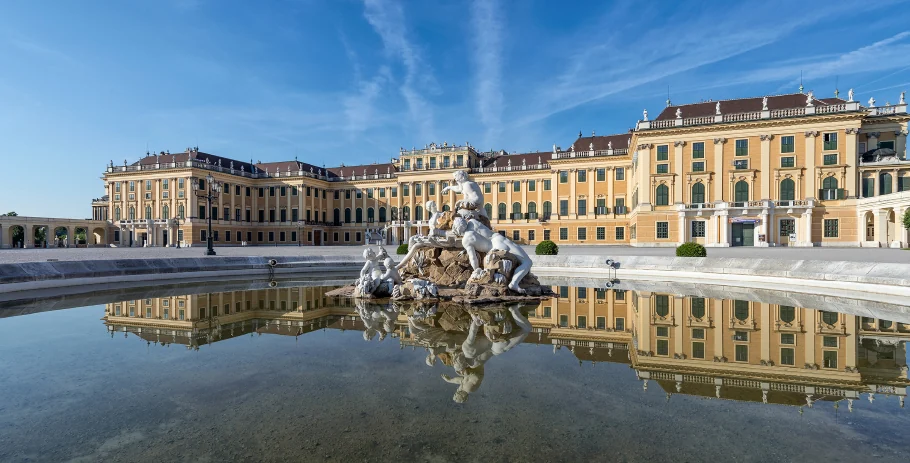
The courtyard pool reflecting the yellow palace front, a fountain sculpture in the middle

Hietzing, Vienna, Austria

Schönbrunn PalaceThe yellow façade in the pool

The still pool in the courtyard turns the whole front façade upside down, and a breath of wind breaks the window reflections into pieces.

In Hietzing, Vienna's 13th district, the palace stands in front and the gardens climb a gentle slope toward the hill.

PlaceHietzing, Vienna, Austria
TypeHabsburg summer palace and gardens
SuitsPalace-room visitors and families trading time between the house and the gardens

An axis that climbs to the hillside

Hietzing, Vienna, Austria — Habsburg summer palace and gardens.

First, take in that pool.

The yellow façade runs horizontally, windows densely ranked, the central stretch stepping slightly forward, the roof pressed flat. The courtyard is spread with gravel, a fountain standing in the middle of the pool; from this end the house and its reflection each take half. Walk toward the wings and the wall suddenly narrows, potted palms set before the water, and the people thin out.

The garden rises due south along a straight line, the parterres laid out square and neat — up close you see only the bed at your feet. At the slope's end stands an open colonnade; climbing from below takes some effort, and looking back the whole yellow wall shrinks to a line. Inside and outside are two lights, separated only by that front gate.
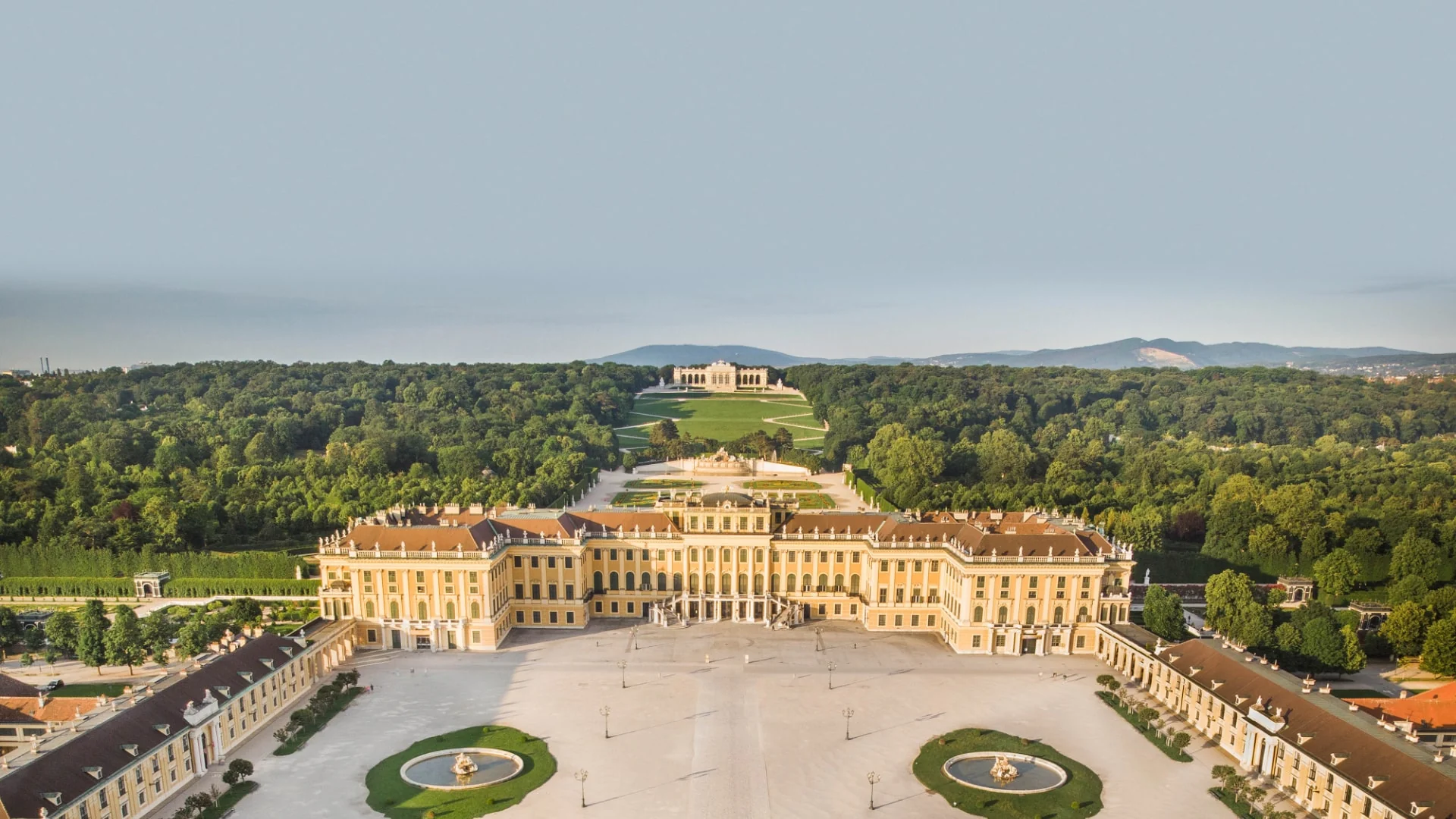
From a palace window looking to the garden, the Gloriette on the hill at the end
The Gloriette seen at the garden's far end
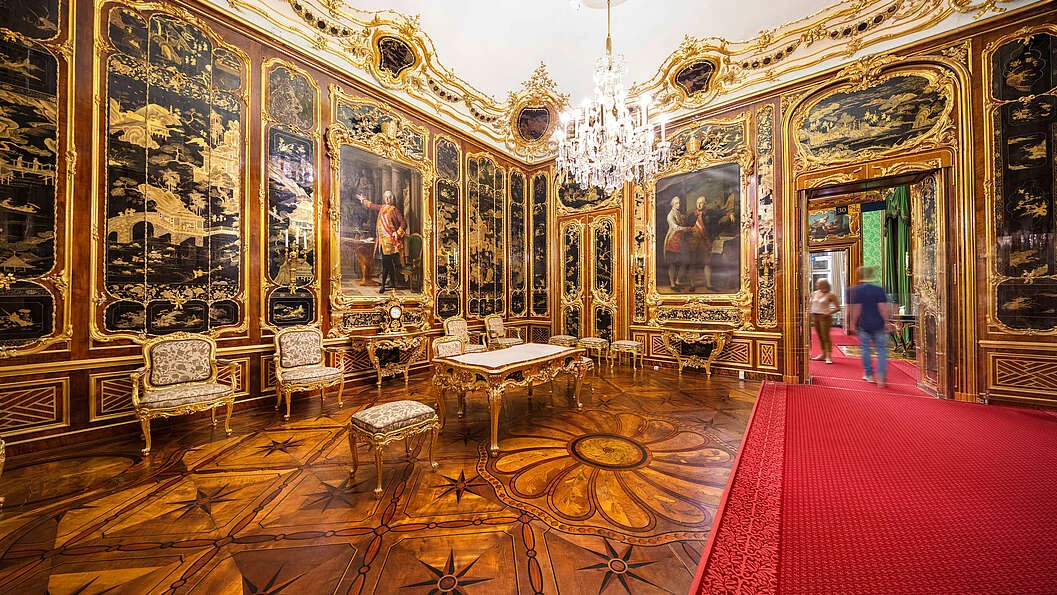
The lacquer room's dark wood panelling with pictures, chairs and a table on the floor
The dark lacquer room with its panelled walls
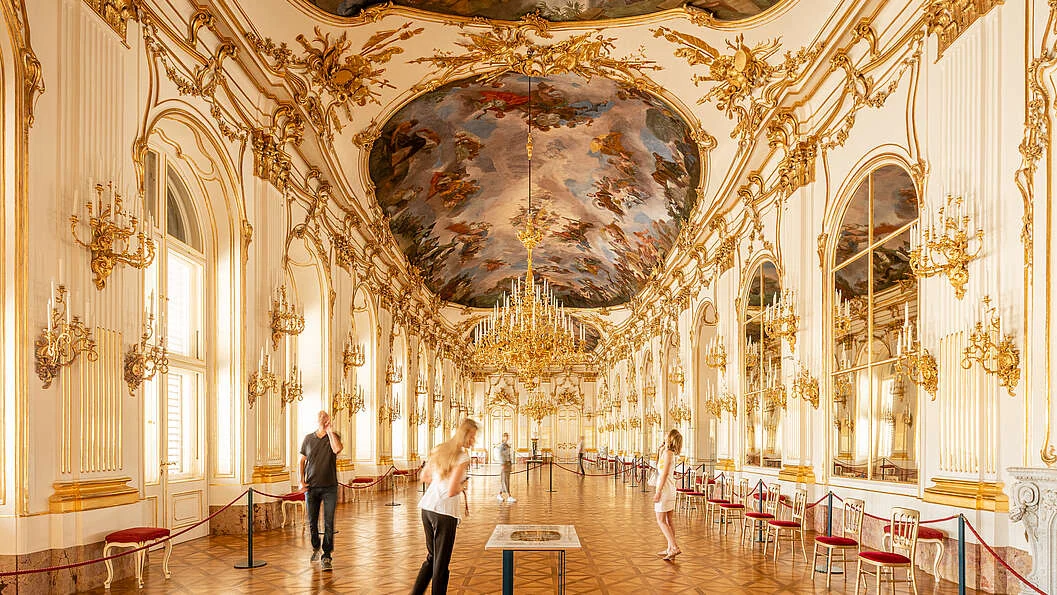
The white Great Gallery with gold trim and a chandelier, a ceiling painting above

The white of the Great Gallery

Gold mouldings are set into the white walls, the ceiling painting pressing at the centre, a chandelier hanging from high above. The floor is fine parquet, and a few people scattered through amplify their footsteps in the empty room. Windows line one side, and only when the light comes in do the gold mouldings show their layers.

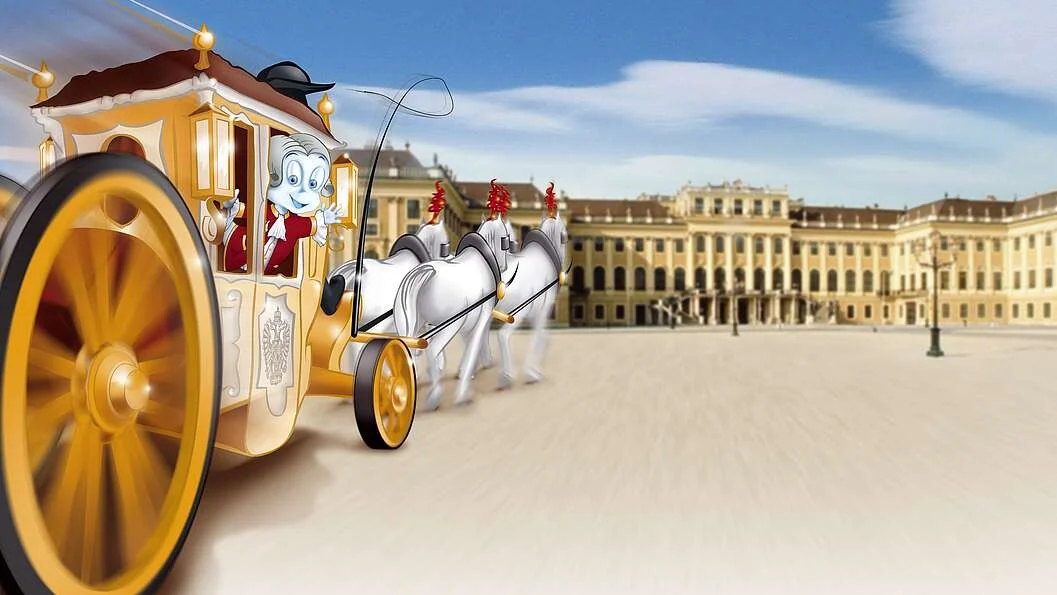
A carriage with golden wheels before the palace, white horses harnessed in front

A golden wheel in the square

The golden wheel of a carriage fills most of the frame, white horses harnessed in front, the reins pulled taut. Behind, the rows of yellow windows count off tier by tier; the square is empty, a wide stretch of stone between the carriage and the palace.

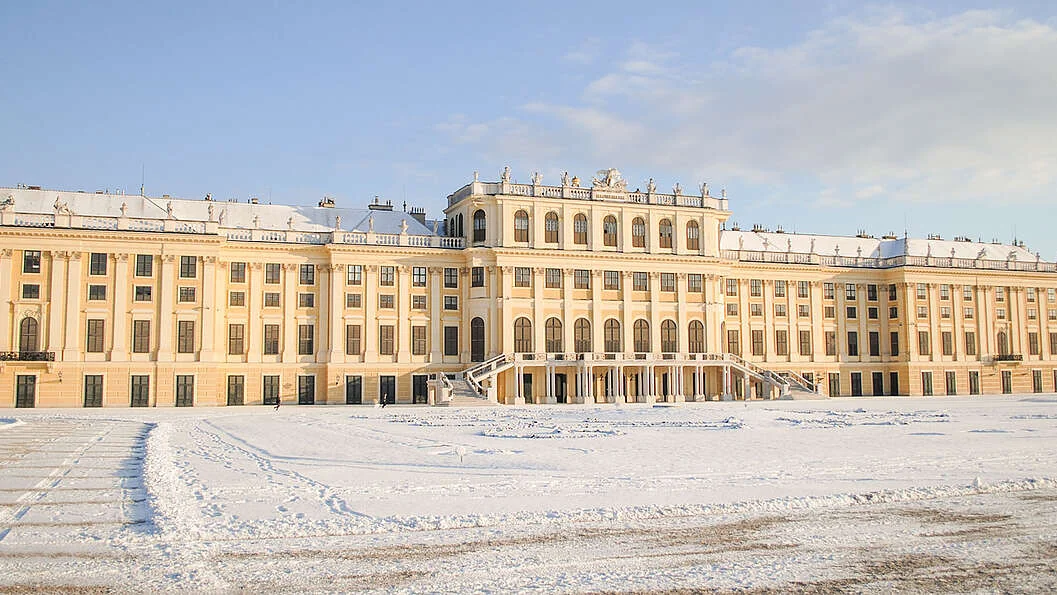
The yellow palace front in winter snow, cart tracks left on the ground

Snow presses the colour down

In winter the front is still that row of windows, cart tracks left in the snow, the line of the eaves clearer than on a clear day. The yellow wall loses its glare in the grey sky; the whole house seems drawn into a cool tone, and few people stand at the gate.

A still pool before the palace's yellow side wing, potted palms at its edge
Route

A full day you leave for western Vienna

Do not put the rooms and the hilltop in the hour you are catching a train; see the rooms first, walk up from the parterre, and return along the wing to the pool.

From hunting ground to summer palace

When Maximilian II bought this riverside lowland in 1569, it was not yet a palace. He had it enclosed and stocked with pheasants, ducks, deer and wild boar for court hunting, dug fishponds, and set aside a small plot for turkeys and peacocks. The Katterburg manor house, built by the previous owner in 1548, stood nearby, and for a century after this remained hunting ground.

After Ferdinand II died, Eleonora Gonzaga took the land as a widow's residence and added a palace to the old house between 1638 and 1643. The name Schönbrunn first appears on an invoice from 1642. Even then it was only a country house with a garden outside the city, with no relation to the long axis that came later.

In the 1740s and 1750s Maria Theresa remade the estate into the Baroque summer palace of today, received as a wedding gift. Franz I then had the exterior redecorated in the Neoclassical style — the yellow wall we see now. When the monarchy ended in 1918 the palace passed to the new Austrian Republic and has been preserved as a museum ever since.

One thousand four hundred and forty-one rooms

Wikipedia records the Baroque palace as having 1,441 rooms. Visitors enter only a few chains of them; the rest serve their own purposes and you will not pass through one by one. The lacquer room's panelling runs deep with inlaid pictures, a few pieces of furniture on the wood floor, light coming only from the windows on one side.

Franz Joseph was born in this house and died here too, on 21 November 1916, aged eighty-six. Most of the furnishings kept are arranged as they were in his century — the tablecloths, chair covers and which picture hangs where belong to a particular year's setting. When you see the house, it is enough to note the beams, parquet and window positions; the furnishings change.

Out of the rooms and back to the courtyard, the space suddenly opens. The fountain stands in the middle, and only when the wind dies do the two rows of windows line up. This is the spot to look back — the scale indoors and that wall outside are simply not the same thing.

The axis climbs a 60-metre hill

In 1695 Jean Trehet, a pupil of André Le Nôtre, planned the French garden here. The carved flowerbed between palace and Neptune Fountain is called the Great Parterre, and the paths run south from it, rising all the way. The parterre pattern cannot be taken in up close — you see how the green plots are clipped into symmetry only from a palace window above.

The garden's axis points to a 60-metre hill, crowned since 1775 by the Gloriette. Built from stone salvaged from demolished buildings, it was meant to speak of Habsburg power and the 'just war'. Its colonnade opens on one side, and from beneath it you can see the whole axis receding.

In 1996 the palace and gardens together were listed as a World Heritage Site, recognised for the Baroque whole and the union of the arts. The still pool by the side wing sits at the edge of the courtyard, potted palms before the water — a good place to rest when tired. The hillside is windy; wear comfortable shoes.

Give the afternoon to this slope

A string of rooms inside, an upward axis outside, with the front courtyard between them.

Dates

Check current notices for the palace and garden's open areas; rooms, garden and other sites each run on their own schedule.

Duration

A few chains of rooms plus the great parterre take half a day; add one or two hours to reach the Gloriette on the hill.

Season

The garden changes with the season — snow before the façade in winter, the parterre patterns clearest in summer. The hillside is windy; the season you pick changes how long you stay outdoors.

Talk through my trip idea

If you are planning your Vienna days, tell me whether you will leave half a day or a full day, and whether there are children with you.

[email protected]

Read this page in Chinese

Discuss this journey