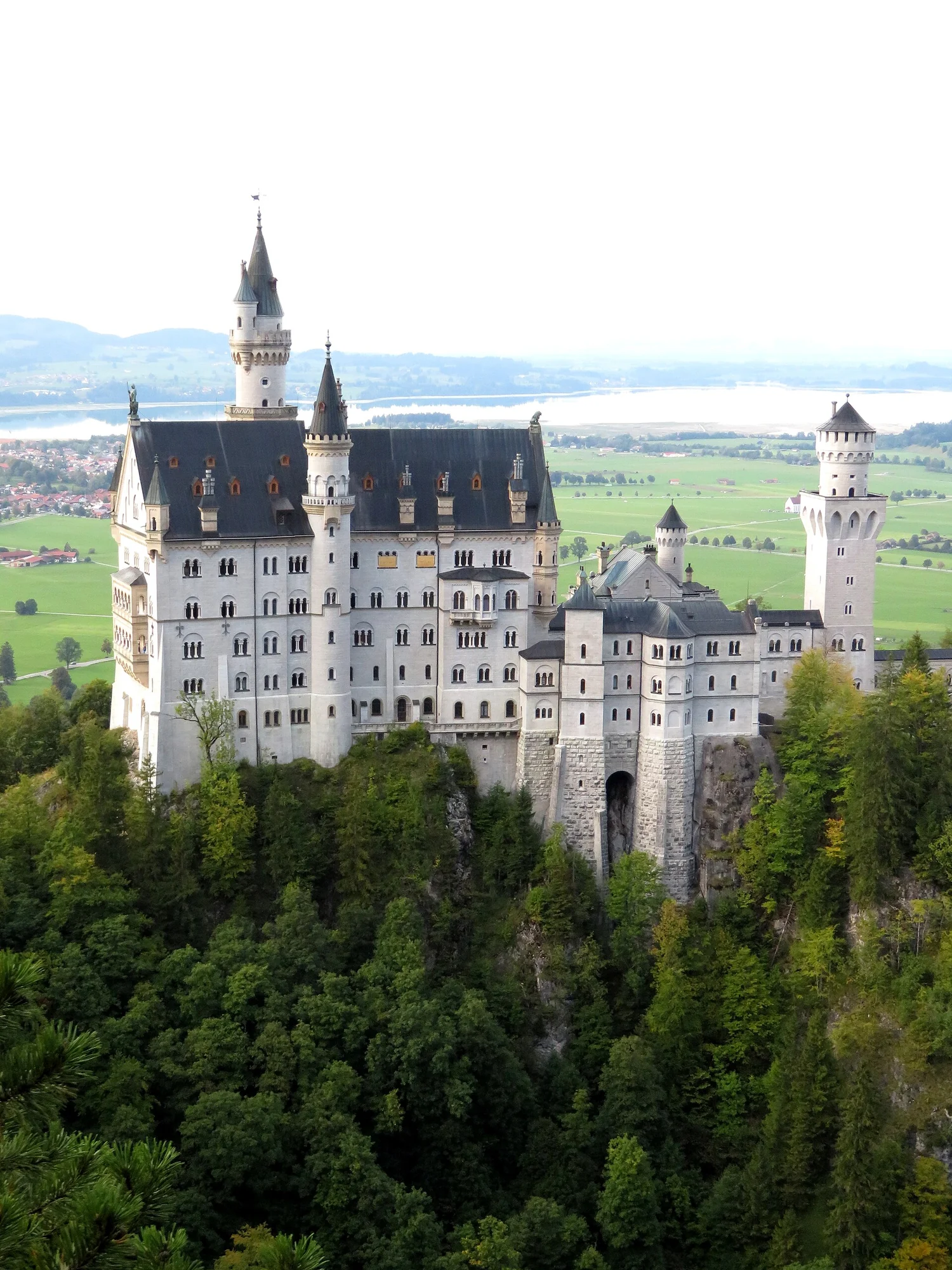
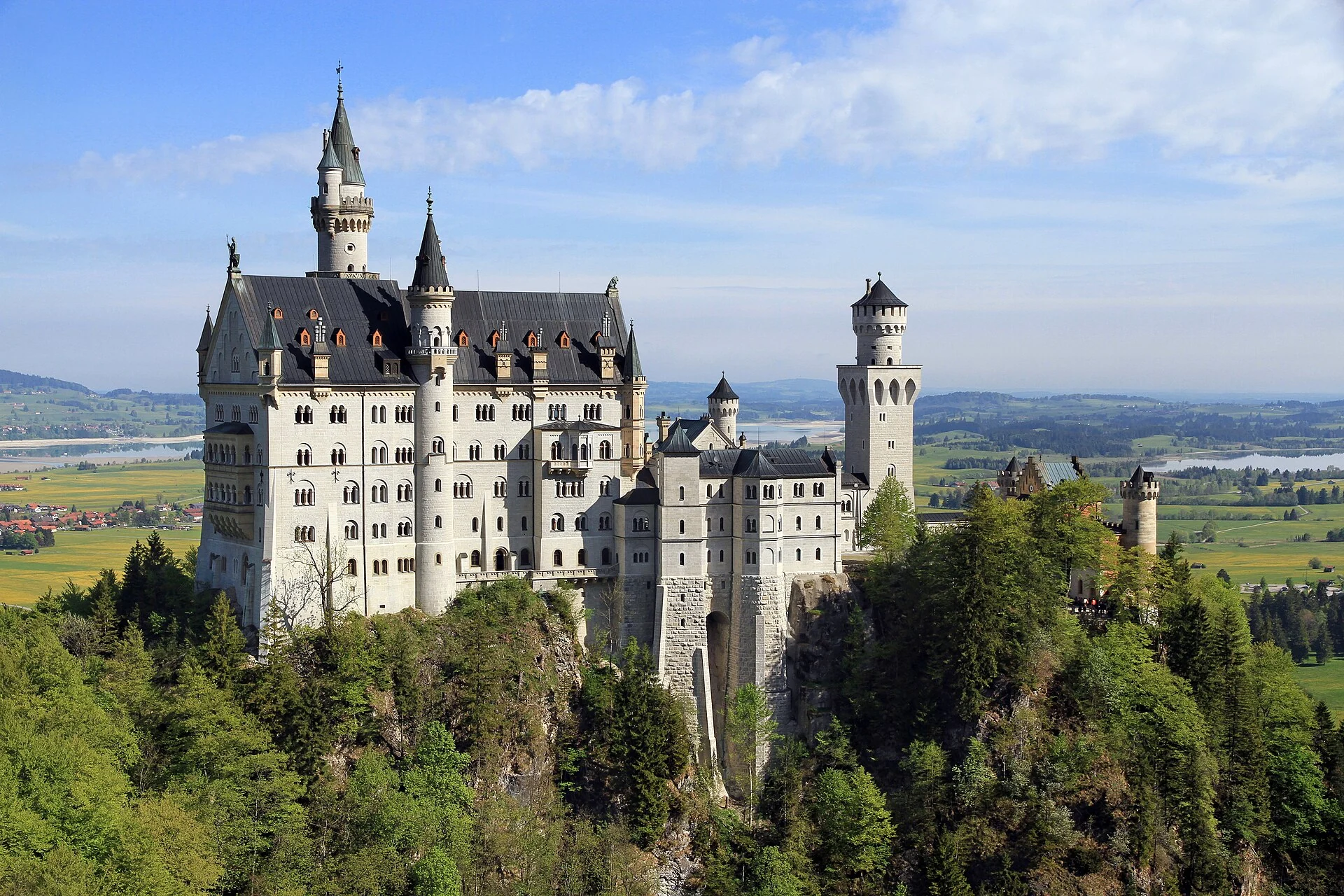
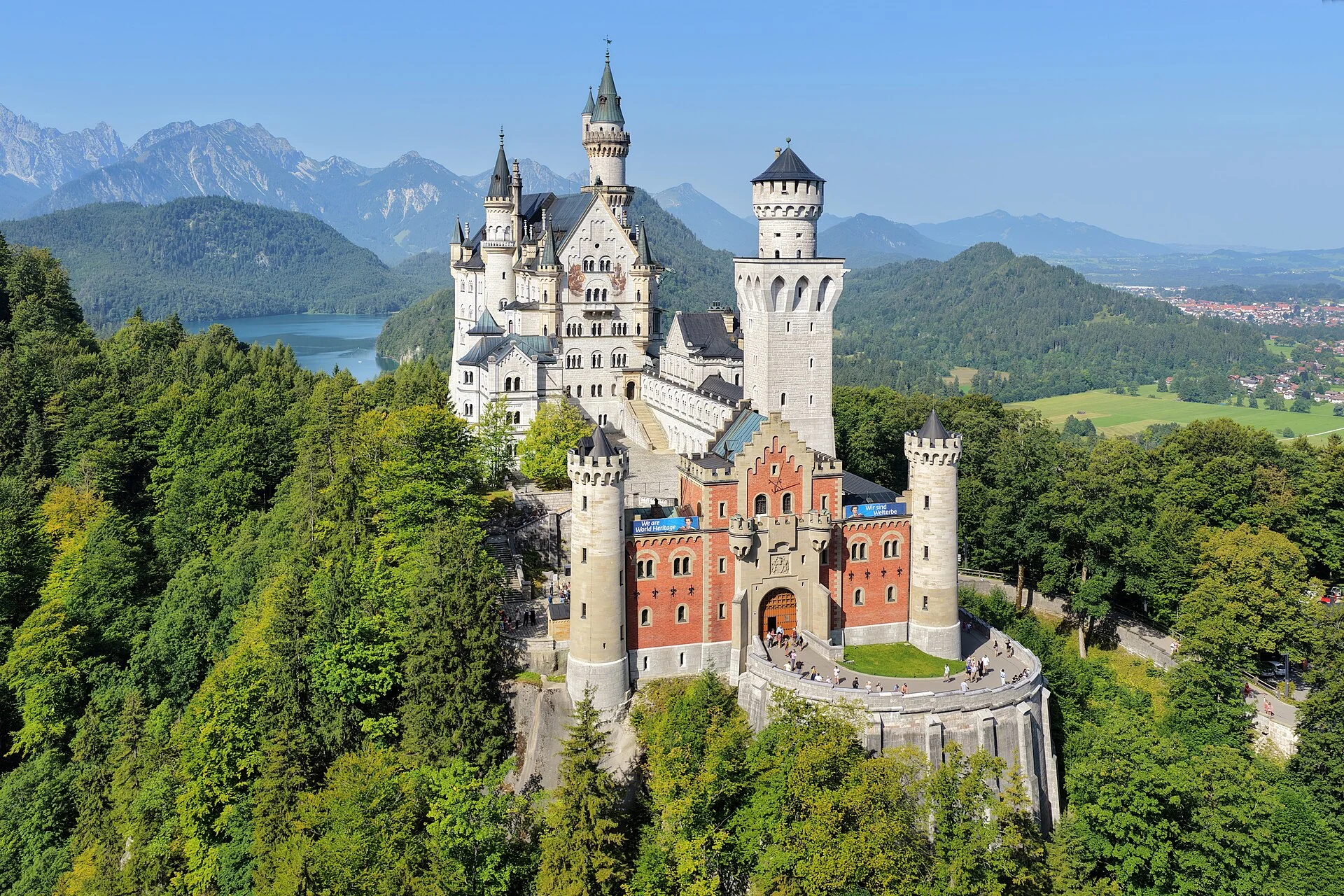
White-walled castle standing on a green slope with a plain and distant lake behind

Schwangau, Bavaria, Germany

Neuschwanstein CastleWhite walls on a green slope

From below, the spires step inward tier by tier and the white walls glow against the trees. Up close you learn these stoneworks are no medieval survivors but a building raised little over a century ago in the image of a knight's castle.

In southern Bavaria, the house sits above a narrow gorge cut by the Pollat stream, with the Alpsee to its east.

PlaceSchwangau, Bavaria, Germany
TypePalace building
SuitsTravelers who want to understand why the spires look old but aren't
Best seasonAutumn or thin-cloud days reveal the layering best

Valley and towers

Schwangau, Bavaria, Germany — Palace building.

Take in the white walls and the plain behind them together from the lower slope.

The three-wing house spreads along the ridge; walk half a circle and you can see which face was finished last.

The themes inside a few of the rooms don't line up with the exterior, worth knowing before you step inside.

Dusk valley with lake and scattered lights at the foot, trees darkening on the slope
The valley at dusk
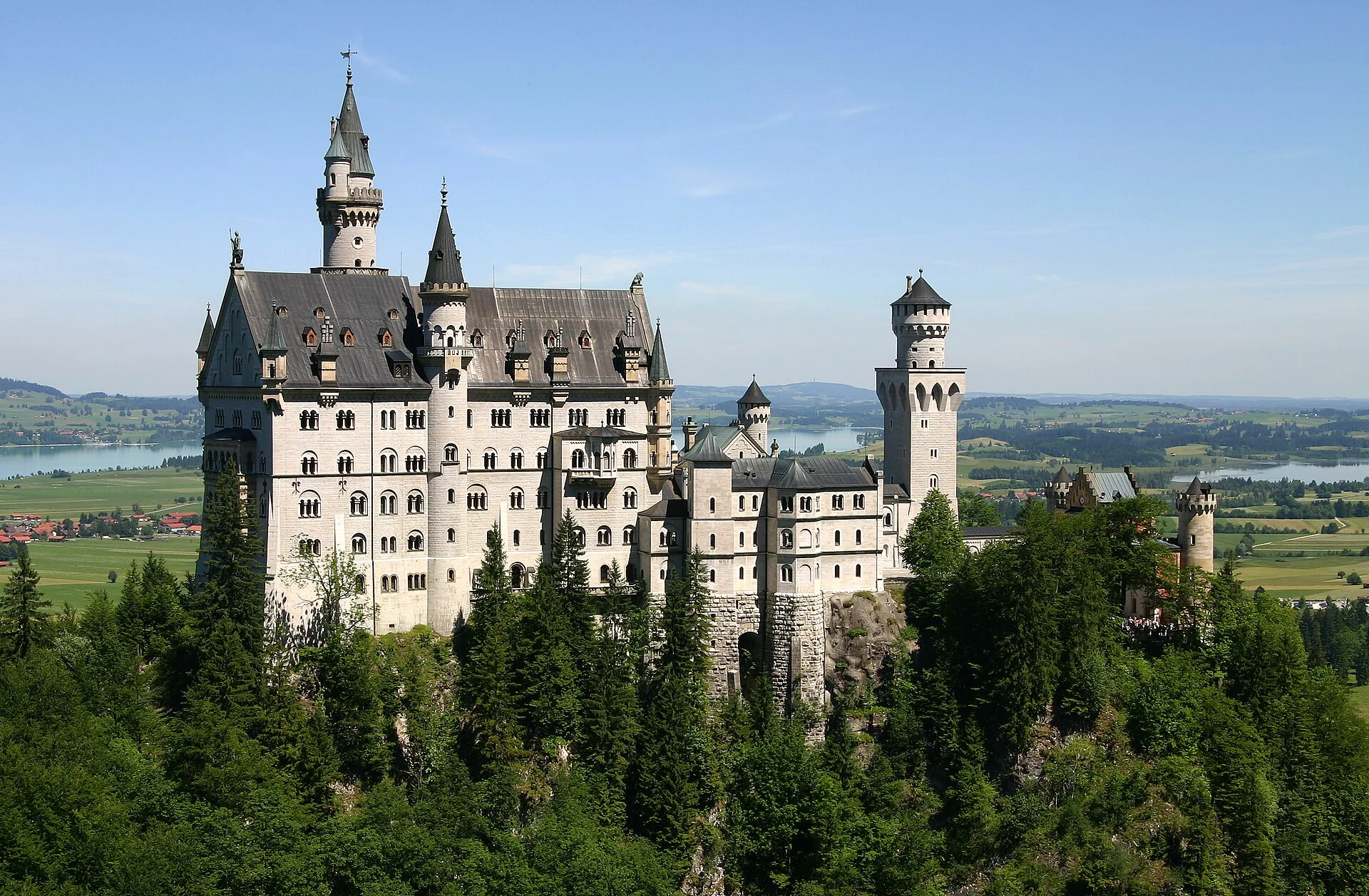
Castle facade layered with distant lake and mountains
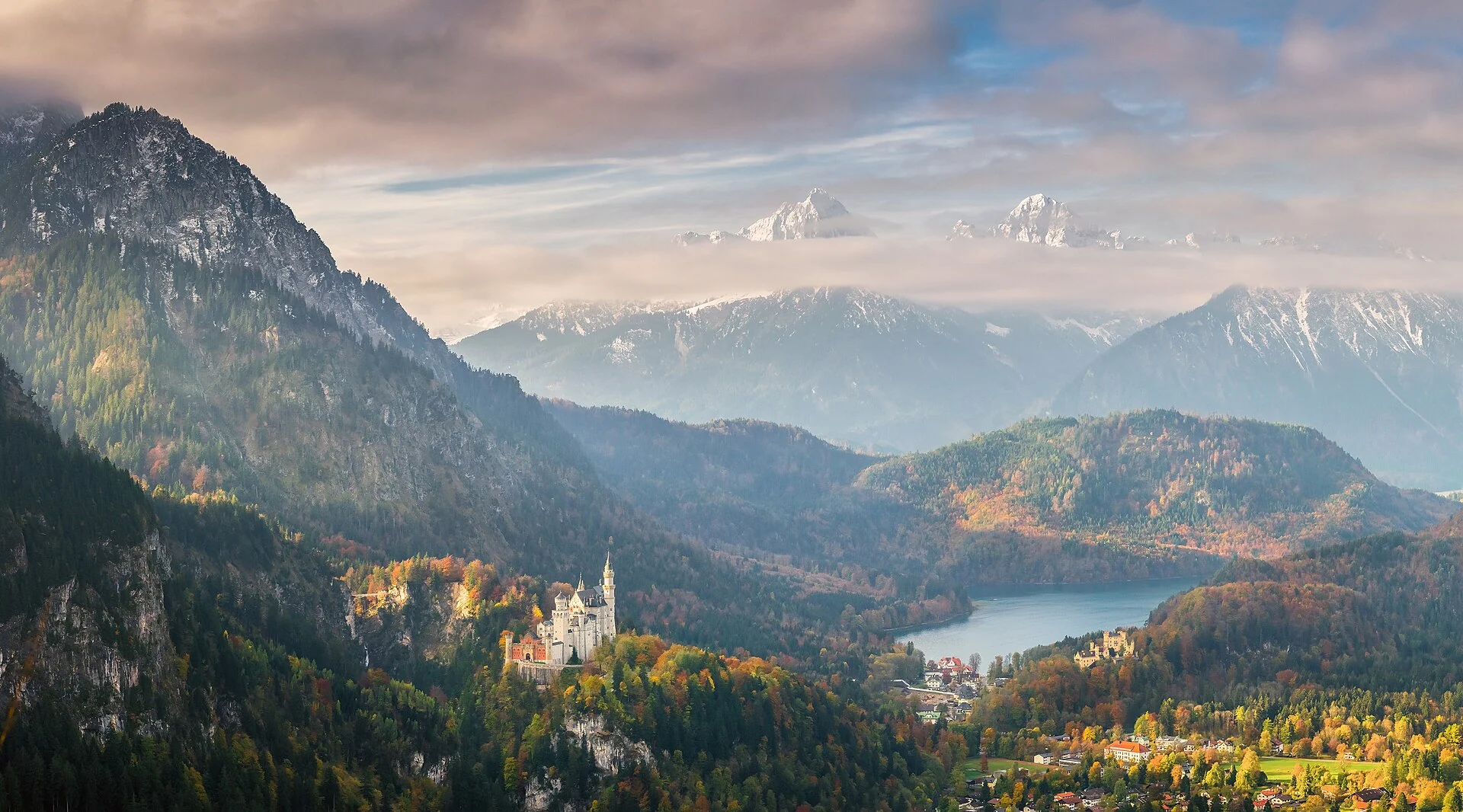
Towers between lake and mountain
Castle viewed from the bridge, green trees on both sides, plain reaching the horizon

The ground above the narrow gorge

The castle stands above a gorge cut by the Pollat stream, with the Alpsee and Swan Lake to its east and, beyond, the mouth where the Lech flows into Forggensee. Old castle ruins once stood here; in 1832 Ludwig's father bought the land and turned it into the more livable Hohenschwangau Palace. The new castle was sited on the slope above the old one.

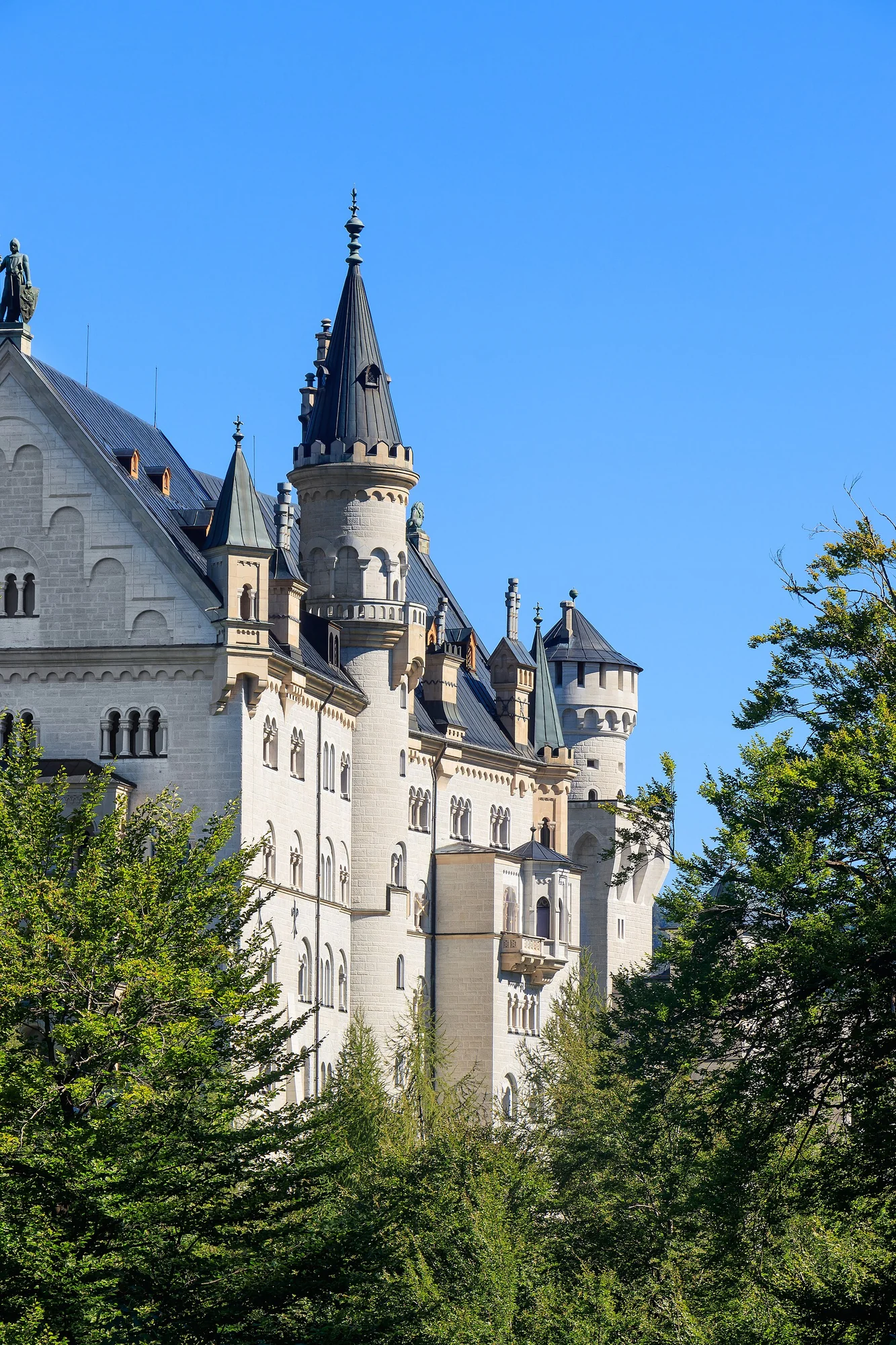
Looking up at white towers, blue sky behind spires and a row of small turrets

Three wings built over two decades

Construction began in 1869 and stretched more than twenty years, finishing in 1892. The work was paid from the king's own private funds and loans, not the Bavarian treasury. Three wings follow the ridge with towers of varying heights; from the valley floor they look slimmer than they are.

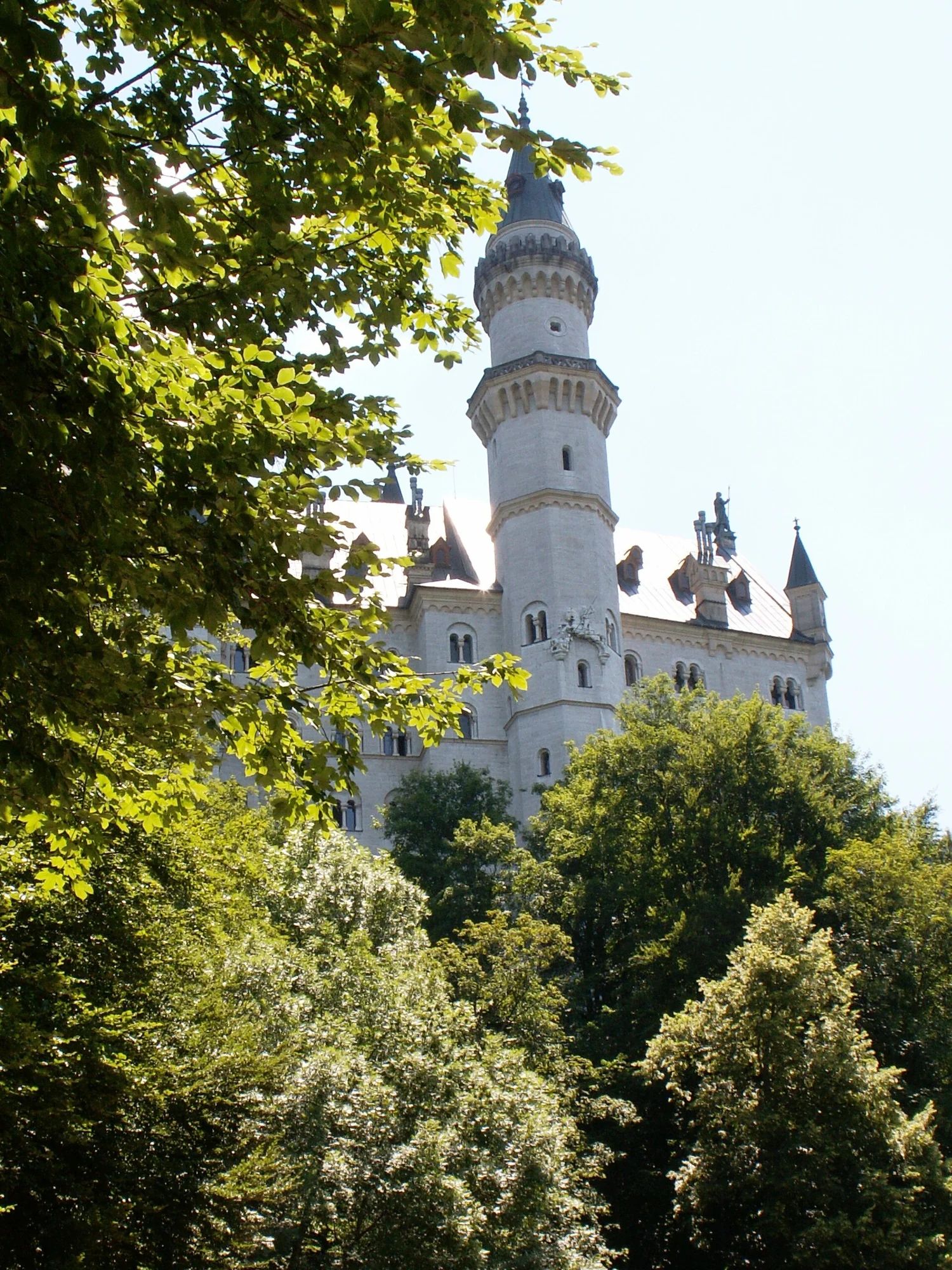
A white tower glimpsed between tree shadows, bright green foliage in the foreground

The rooms inside

The throne room, bedroom and singers' hall are the three most often named interiors; their walls carry medieval legends, speaking a different language from the neo-Romanesque stonework outside. In 2025 this house, together with Linderhof, Schachen and Herrenchiemsee, was inscribed on the World Heritage List under the palaces of Ludwig II.

Lower red-brick wall of the castle with continuous green hills behind
Route

A half-day on the ridge

Don't slot it on a transfer day. Stay the night before in Schwangau or Fussen, climb in the morning, and you'll still have energy for the lakeside in the afternoon.

The white house on the ridge

Heading into the mountains, you see trees first; the white walls only appear after a bend. The Pollat stream cuts a narrow gorge below, and the house sits above the gorge mouth, with two lakes to its east and, on clear days, a view all the way to Forggensee. The terrain forced it to follow the ridge rather than spread across flat ground.

The land was not empty. In 1832 Maximilian II bought the old castle ruins; in 1837 he rebuilt the old fortress into a summer palace. His eldest son Ludwig was born in 1845 and spent most of his childhood there. The new castle was sited on the slope above the old one, the two houses facing each other across a stretch of woods.

So from the bridge, the picture holds more than one castle. In the foreground are the gorge and the stream; in the middle, the white walls and spires; in the distance, the plain and the lake. Three layers of scenery are pressed into a single line of sight, the angle most often photographed.
A private home never lived in

Work began in 1869 to designs by Eduard Riedel, in the neo-Romanesque style, modelled on a medieval knight's castle. Three wings and a tall tower took more than twenty years, only finished in 1892.

When the king died in 1886, parts of the interior were still unfinished. A house built for solitude became a place open to visitors, leaving even half-finished rooms intact. This half-completed handover is rare among palaces.

Also written into the list are Linderhof, Schachen and Herrenchiemsee, scattered across Bavaria. Strung into a route, the reason this one was never built as a fortress becomes clear: from the start it wanted a picture, not defence.

From the bridge to the door

There is a walking path up, and also a shuttle; the slope is not gentle. Most head first to Marienbrucke, which spans the Pollat gorge, looking back gives the familiar white-wall panorama. When it's crowded the bridge jams; arriving earlier eases it.

Inside, the route is fixed; following it you pass through several rooms, all windows opening onto the valley. The stonework looks old, yet every block was cut by nineteenth-century craft; the wall colour is warmer than in photos, and light from the high windows lights only a small patch.

Don't rush down afterwards. Walk back along the lake; as the light fades the valley lights a few lamps and the white walls recede behind the trees, and the outline seen from the bridge changes. Allow a full half-day; if pressed for time, skip the gardens.

A half-day reserved for the ridge

Read the terrain from the lower slope, climb to the bridge for the full view, finish the interior route inside, then wander back slowly along the lake.

Time needed

Half a day to climb, cross the bridge, do the interior and return along the lake; allow extra time for nearby Schwangau sights.

Opening

Which rooms are open and whether entry is timed changes by period; the bridge is capacity-controlled in peak season.

Access

The climb is sloped and the interior follows a fixed route with stairs; check current accessible routes in the notice.

Best light

Midday summer glare is harsh; autumn colour or thin cloud reveals the layering of trees and stone.

Talk through my trip idea

If you're planning those days in Bavaria, tell me whether you'll keep half a day or a full one, and whether anyone in your group moves slowly.

[email protected]

Read this page in Chinese

Discuss this journey